Power of Compounding: How Small Investments Can Create Big Wealth Over Time

Imagine investing just ₹5,000 every month and watching it grow into more than ₹1 crore over time—not because you earned a massive salary or picked the perfect stocks, but because you started early and stayed invested.
Sounds unbelievable?
That’s the power of compounding.
Have you ever wondered how ordinary people gradually build significant wealth over time—even without earning exceptionally high salaries or making risky investments?
The answer often comes down to one simple yet powerful financial principle: compounding.
Compounding allows your money to earn returns, and then those returns begin earning returns of their own. Over time, this creates a powerful snowball effect, where even small, consistent investments can grow into substantial long-term wealth.
This is why many successful investors focus less on chasing the next “hot” investment and more on starting early, investing consistently, and remaining invested for the long term.
Whether your goal is financial independence, early retirement, buying your dream home, or building wealth for your family’s future, understanding the power of compounding can completely change the way you think about investing.
The best part?
You don’t need a finance degree, advanced investing knowledge, or a huge income to benefit from compounding. You simply need:
- Time
- Consistency
- Patience
In this beginner-friendly guide, you’ll learn:
- What compounding is and how it works
- The difference between simple and compound interest
- Why starting early matters more than investing larger amounts
- How the Rule of 72 estimates investment growth
- How inflation affects your wealth
- Practical ways to maximize the power of compounding
Let’s begin by understanding what compounding actually means.
- What Is Compounding?
- Simple Interest vs. Compound Interest
- How Compounding Accelerates Wealth Creation
- The Compound Interest Formula
- Why Compounding Is Like a Financial Snowball
- Examples of Compounding
- The Rule of 72: How Fast Your Money Can Double
- 🧠 Did You Know About Rule of 114 and Rule of 144?
- The Silent Wealth Killer: How Inflation Affects Compounding
- Power of Compounding in the Stock Market
- Compounding Success: The Secrets Behind Long-Term Wealth
- Practical Step-by-Step Action Plan for Beginners
- Final Thoughts: The Real Power of Compounding
- Next Read: Savings vs. Compound Interest Calculator
- ❓ Frequently Asked Questions (FAQs) About the Power of Compounding
- Glossary
- Key Takeaways: How Compounding Works
- Final Thoughts: How Compounding Builds Wealth Over Time
- What to Read Next
What Is Compounding?
Compounding is the process of earning returns not only on your original investment but also on the returns that your investment has already generated. In other words, your money starts earning money, and over time, those earnings begin earning money too.
This process is known as compound interest when applied to interest-bearing investments, and it’s one of the most powerful ways to build long-term wealth.
💡 In Simple Words
Imagine planting a small seed.
At first, it grows into a tree. Over time, that tree produces hundreds of new seeds, each with the potential to grow into more trees. As this cycle continues, growth accelerates naturally.
Compounding works in much the same way.
Your initial investment earns returns. Those returns remain invested and generate additional returns. Over the years, this creates a powerful snowball effect, where your wealth grows faster because every new gain becomes part of the amount earning future returns.
The longer your money stays invested, the more powerful compounding becomes.
💡 Did You Know?
Investing ₹10,000 per month for 30 years at a 12% annual return can potentially create a corpus of over ₹3.5 crore, while the total investment is only ₹36 lakh. The difference comes from the magic of compounding.
Simple Interest vs. Compound Interest
To truly appreciate the power of compounding, it’s important to understand how it differs from simple interest.
Although both help your money grow, the way they calculate returns is very different.
| Simple Interest | Compound Interest |
|---|---|
| Earns returns only on your original investment (principal). | Earns returns on both your original investment and the returns already earned. |
| Growth is steady and linear. | Growth accelerates over time. |
| Returns remain the same each period. | Returns increase as your investment grows. |
| Best suited for short-term borrowing or lending. | Ideal for long-term investing and wealth creation. |
📊 A Simple Example
Suppose you invest ₹10,000 and earn 10% annually.
With Simple Interest
- Year 1: You earn ₹1,000. Your total becomes ₹11,000.
- Year 2: Interest is still calculated only on the original ₹10,000, so you earn another ₹1,000.
Your earnings remain the same every year.
With Compound Interest
- Year 1: You earn ₹1,000, increasing your investment to ₹11,000.
- Year 2: Interest is now calculated on ₹11,000, not ₹10,000. You earn ₹1,100, bringing your investment to ₹12,100.
Every year’s earnings become part of the amount that earns future returns.
That extra growth is the power of compounding in action.
How Compounding Accelerates Wealth Creation
A monthly investment of ₹10,000 grows to just ₹36 lakh through savings alone, but with an assumed 12% annual compounded return, the same investment could potentially exceed ₹3.5 crore over 30 years. This illustrates how time and compounding can dramatically influence long-term wealth creation.
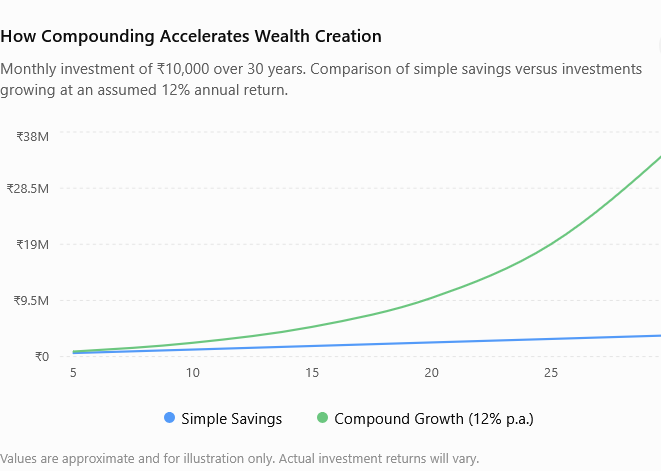
This chart and the following table tell the story visually:
- Simple Savings: ₹36 lakh after 30 years.
- Compound Growth: Around ₹3.5 crore at a 12% annual return.
| Year | Savings | Compound |
|---|---|---|
| 5 | 600000 | 824000 |
| 10 | 1200000 | 2300000 |
| 15 | 1800000 | 5000000 |
| 20 | 2400000 | 9900000 |
| 25 | 3000000 | 19000000 |
| 30 | 3600000 | 35200000 |
Values are approximate and for illustration only. Actual investment returns will vary.
The Compound Interest Formula
If you’re curious about the mathematics behind compounding, the compound interest formula is:
Where:
- A = Final amount
- P = Principal (initial investment)
- r = Annual interest rate
- n = Number of times interest is compounded each year
- t = Time (in years)
You don’t need to memorize this formula to become a successful investor.
The most important lesson is much simpler: The longer your money remains invested, the more opportunities it has to compound and grow.
Time—not mathematical formulas—is the biggest driver of long-term wealth creation.
Why Compounding Is Like a Financial Snowball
One of the easiest ways to understand compounding is to imagine a snowball rolling downhill.
At first, the snowball is small and grows slowly. As it rolls, it gathers more snow, becomes larger, and starts growing faster with every turn.
Compounding works in exactly the same way.
In the early years, your investment earns modest returns. As those returns remain invested, they begin generating additional returns of their own. Gradually, your investment grows larger, allowing each year’s gains to become bigger than the last.
This is why long-term investors often experience the most significant growth in the later years of their investment journey.
What begins as small, consistent growth can eventually become substantial wealth—not because the investment suddenly changes, but because compounding gains momentum over time.
✅ Key Takeaway
Compounding rewards patience. The longer you stay invested, the faster your wealth can grow.
Examples of Compounding
To truly understand the power of compounding, you don’t just need definitions—you need to see it in action.
Let’s look at two simple but powerful examples.
Example A: The ₹1,00,000 One-Time Investment
Imagine you invest a lump sum of ₹1,00,000 in a diversified equity mutual fund that delivers an average 12% annual return. You do nothing else—no additional investment, no withdrawals—for the next 30 years.
Here’s how your money grows:
- Year 1: ₹1,00,000 grows to ₹1,12,000
- Year 2: ₹1,12,000 grows to ₹1,25,440
- Year 10: Your investment reaches ~₹3,10,585
- Year 20: It grows further to ~₹9,64,629
- Year 30: It becomes ~₹29,95,992 (nearly ₹30 lakh)
At first, the growth may feel slow. In the early years, the increase doesn’t look dramatic.
But something interesting happens after time passes.
The growth curve starts to steepen.
Between Year 20 and Year 30, your wealth grows much faster than in the earlier decades—even though you didn’t invest anything extra.
That’s the compounding curve in action.
✅ Key Takeaway
Compounding may look slow in the beginning, but it accelerates significantly over time.
Example B: Why Starting Early Matters
Now let’s compare two investors with the same investment strategy—but different starting points.
Rahul Starts Early
- Monthly investment: ₹5,000
- Annual return: 12%
- Starts investing at age 25
- Invests for 30 years
👉 At age 55, Rahul could accumulate approximately ₹1.76 crore
Arjun Starts Late
- Monthly investment: ₹5,000
- Annual return: 12%
- Starts investing at age 35
- Invests for 20 years
👉 At age 55, Arjun may accumulate approximately ₹50 lakh
The Real Difference?
Rahul didn’t invest more aggressively. He didn’t take more risk.
He simply gave compounding 10 extra years to work.
And those 10 years created a massive difference in final wealth.
✅ Key Takeaway
In compounding, time is more powerful than the amount you invest.
Real-Life Examples of Compounding
Compounding isn’t limited to theoretical examples—it works in real financial products you may already be using.
Savings Accounts
Banks pay interest on your balance. When that interest stays in the account, future interest is calculated on a higher amount, creating compounding over time.
Mutual Funds
Many mutual funds reinvest profits automatically, allowing your investment to grow continuously without manual intervention.
Dividend Reinvestment
When dividends are reinvested instead of withdrawn, they buy more shares, which in turn generate more dividends in the future.
Retirement Investing
Retirement portfolios rely heavily on long investment horizons. The longer the money stays invested, the stronger the compounding effect becomes.
Now that you understand how compounding works, the next obvious question is:
How long does it actually take for your money to double?
That's where the Rule of 72 becomes useful.
The Rule of 72: How Fast Your Money Can Double
Have you ever wondered how long it will take for your money to double?
You don’t need a financial calculator or complex formulas to figure it out. There is a simple mental shortcut called the Rule of 72 that gives you a quick estimate.
The Rule of 72 is a simple formula used to estimate how many years it will take for your investment to double at a fixed annual return.
Formula: Years to Double = 72 ÷ Annual Return Rate
This means you simply divide 72 by the expected rate of return to get an approximate doubling time.
It’s not perfectly precise—but it’s surprisingly close and extremely useful for quick financial decisions.
📊 Simple Example
Let’s say your investment earns 12% per year.
Using the Rule of 72: 72 ÷ 12 = 6 years
So, your money will approximately double every 6 years.
What this looks like in real life
| Time Period | Investment Value |
|---|---|
| Initial Investment | ₹1,00,000 |
| After 6 years | ₹2,00,000 |
| After 12 years | ₹4,00,000 |
| After 18 years | ₹8,00,000 |
| After 24 years | ₹16,00,000 |
Notice how the growth doesn’t just continue—it accelerates over time. That is compounding at work.
Try It Yourself (Quick Mental Math)
Let’s apply the Rule of 72 to different types of investments:
🏦 Fixed Deposit (6% return)
72 ÷ 6 = 12 years to double your money
📊 Balanced Mutual Fund (9% return)
72 ÷ 9 = 8 years to double your money
📈 Equity Fund / SIP (12% return)
72 ÷ 12 = 6 years to double your money
👉 “Try the calculator below to see your own results instantly.”
Rule of 72 Calculator
Enter your expected annual return to see how long it takes to double your money.
What This Really Teaches You
The Rule of 72 is not just a shortcut—it reveals a powerful truth:
Even small differences in returns can dramatically change your long-term wealth.
For example:
- 6% returns → 12 years to double
- 12% returns → 6 years to double
That’s twice as fast, simply because of a higher return rate.
💭 Think About This
If you have ₹5,00,000 today, do you want it to become ₹10,00,000 in:
- 12 years?
- 8 years?
- or 6 years?
The answer depends entirely on the type of investment you choose—and how early you start. The higher your returns—and the earlier you start—the faster your money grows.
✅ Key Takeaway
The Rule of 72 gives you a simple way to understand the power of compounding without complex math.
🧠 Did You Know About Rule of 114 and Rule of 144?
The Rule of 72 isn't the only quick mental shortcut for estimating investment growth:
- Rule of 72 → Divide 72 by your annual return (%) to estimate how many years it takes to double your money.
- Rule of 114 → Divide 114 by the annual return (%) to estimate how long it takes to triple your investment.
- Rule of 144 → Divide 144 by the annual return (%) to estimate how long it takes to quadruple your money.
Example: At a 12% annual return, your investment could approximately:
- Double in 6 years (72 ÷ 12)
- Triple in 9.5 years (114 ÷ 12)
- Quadruple in 12 years (144 ÷ 12)
💭 Keep in mind: These are handy estimation rules that assume a constant annual rate of return with compounding. Actual investment performance can vary due to market fluctuations, fees, taxes, and changes in returns.
The Silent Wealth Killer: How Inflation Affects Compounding
While compounding helps your money grow over time, there is another powerful force working in the opposite direction: inflation.
Inflation is the gradual increase in the price of goods and services over time. In simple terms, it reduces the purchasing power of your money.
This means: ₹100 today will not buy the same things 10, 20, or 30 years from now.
This is why investing is not just about growing your money—it is about ensuring your money grows faster than inflation.
Nominal Returns vs Real Returns
When you look at investment returns, there are two ways to measure growth:
Nominal Return
This is the return shown on paper—before adjusting for inflation.
Example: A mutual fund gives 12% annual return
Real Return
This is your actual increase in purchasing power after adjusting for inflation.
Formula: Real Return = Nominal Return − Inflation Rate
Example:
- Investment return = 12%
- Inflation rate = 6%
- Real return = 6%
So even though your money grew by 12%, your actual purchasing power increased by only 6%.
The Chocolate Box Reality Check
Imagine a premium box of chocolates costs ₹1,000 today.
If inflation averages 6% per year, the same box could cost nearly ₹5,700 after 30 years.
Now think about this: If you simply store ₹1,000 in cash for 30 years, it will still be ₹1,000.
But its value will shrink dramatically in real terms—you would only be able to buy a fraction of what you can buy today.
✅ Key Insight
Saving money alone is not enough. Your money must grow faster than inflation to preserve its value.
Compounding vs Inflation: A Reality Check
Let’s understand how inflation impacts long-term investing with a simple comparison.
Assume:
- Initial investment: ₹10,00,000
- Time period: 25 years
- Inflation: 6% annually
Scenario A: Low Return (5% per year)
- Final value: ~₹33.8 lakh
- Inflation-adjusted value: ~₹7.8 lakh (today’s purchasing power)
Even though the number looks bigger, your real wealth has actually decreased.
✅ Key Insight
If returns are lower than inflation, your wealth loses value over time.
Scenario B: Wealth-Building (12% per year)
- Final value: ~₹1.7 crore
- Inflation-adjusted value: ~₹39.5 lakh (today’s purchasing power)
Even after inflation, your money has grown significantly in real terms.
✅ Key Insight
When returns beat inflation, compounding creates real wealth—not just higher numbers.
Inflation Impact Calculator
🔥 Try adjusting inflation and time to see how purchasing power changes
The Ultimate Lesson
Compounding is powerful—but it only works in your favor when combined with inflation-beating returns.
To build real long-term wealth, your investments should:
- Grow faster than inflation
- Stay invested for long periods
- Benefit from compounding over time
This is why many long-term investors focus on:
- Diversified equity mutual funds
- Index funds
- Equity investments
- Long-term retirement portfolios
✅ Key Insight
The real goal of investing is not to see a bigger number in your account. It is to ensure that your money retains—and increases—its future purchasing power. That is what true financial growth means.
Power of Compounding in the Stock Market
The stock market is one of the most powerful places where compounding can truly work in your favor—but only if you stay invested long enough.
Unlike fixed deposits or savings accounts, the stock market allows your wealth to grow through multiple layers of compounding over time.
This happens in three main ways:
- Capital appreciation (increase in stock prices over time)
- Dividend reinvestment (earnings that are reinvested to buy more shares)
- Long-term business growth (companies growing revenues and profits year after year)
When these three forces combine, your money doesn’t just grow—it compounds at scale.
This is why long-term investors often ignore short-term market movements and focus instead on time in the market, not timing the market.
Compounding Through SIP Investments
One of the simplest and most effective ways to benefit from compounding is through a Systematic Investment Plan (SIP).
A SIP allows you to invest a fixed amount every month into mutual funds automatically.
You can start with as little as ₹100 to ₹500 per month, making it accessible for almost everyone.
⭐ What makes SIPs powerful?
Instead of trying to predict the market, SIPs allow compounding to work naturally in the background.
With SIPs:
- Your investments happen automatically every month
- Your returns are continuously reinvested
- Your wealth builds gradually but consistently
Over time, this creates a strong compounding effect—especially when combined with long investment durations.
⭐ Why SIPs Are So Effective
- Builds Investing Discipline: SIPs help you develop a habit of investing regularly, without emotional decision-making.
- Removes Market Timing Pressure: You invest the same amount every month, whether markets go up or down. This removes the stress of “when to invest.”
- Benefits from Market Volatility (Rupee Cost Averaging): When markets fall, your SIP buys more units. When markets rise, it buys fewer units. Over time, this helps smooth out your purchase cost.
- Start Small, Grow Big: You don’t need a high salary to begin investing. Even small SIPs can grow significantly when given enough time.
📊 SIP Growth Example
Let’s take a realistic example:
- Monthly SIP: ₹5,000
- Duration: 20 years
- Expected return: 12% annually
👉 Total invested: ₹12 lakh
👉 Estimated value: ~₹50 lakh
That’s the power of consistency combined with compounding.
📊 SIP Wealth Building Snapshot
| Monthly SIP | 10 Years | 20 Years | 30 Years |
|---|---|---|---|
| ₹2,000 | ₹4.6 lakh | ₹20 lakh | ₹70 lakh |
| ₹5,000 | ₹11.5 lakh | ₹50 lakh | ₹1.7 crore |
| ₹10,000 | ₹23 lakh | ₹1 crore | ₹3.4 crore |
Lesson: Notice how the growth in the later years becomes dramatically faster. That acceleration is not due to higher investments—but due to compounding gaining momentum over time. That is why starting early matters more than amount!
If there is one lesson learned from this example, it is this:
Time matters more than money when it comes to compounding.
Here’s why:
- Small investments started early often outperform large investments started late
- Compounding needs time to accelerate
- The last 10 years often contribute more wealth than the first 10 years
Key Insight
Compounding in the stock market is not about predicting the next big stock.
It is about:
- Staying invested for long periods
- Investing consistently through SIPs
- Allowing businesses to grow over time
When you combine patience with consistency, compounding does the rest.
That is how long-term wealth is actually built.
✅ Pro Tip
Increase your SIP by 5–10% every year whenever your income grows. This small habit can substantially increase your long-term wealth without feeling like a major financial burden.
Compounding Success: The Secrets Behind Long-Term Wealth
Understanding compounding is easy.
Sticking with it for decades is the real challenge.
Most people know what to do—but very few actually do it long enough to see results.
Long-term wealth is not built by complexity. It is built by following a few simple principles consistently over time.
A) The 4 Key Ingredients of Compounding
To unlock the full power of compounding, you need to understand four key forces that drive long-term wealth creation:
1. Time (The Catalyst)
Time is the most powerful force in compounding. Starting early is not just an advantage—it is a multiplier.
The earlier you start, the more time your money has to grow—and the more powerful the compounding effect becomes.
Even a small delay can significantly reduce long-term wealth because you lose the most valuable ingredient: years of growth.
2. Consistency (The Fuel)
Wealth is not built by occasional investments. It is built by regular, disciplined investing, usually through SIPs.
Consistency ensures that your capital base keeps increasing steadily, allowing compounding to work on a growing foundation.
Even small monthly investments, when done consistently, often outperform large but irregular investments.
3. Rate of Return (The Speed)
Returns determine how fast your money grows. A higher return accelerates compounding, but it also comes with higher risk.
This is why successful investors focus on balanced, long-term returns rather than chasing unrealistic gains.
Compounding works best when returns are stable and sustainable over long periods.
4. Patience (The Real Test)
Compounding feels slow in the beginning. For years, growth may seem insignificant. But over time, the curve starts rising sharply.
Unfortunately, many investors quit before they reach this phase.
Patience is what separates those who understand compounding from those who benefit from it.
B) Common Mistakes That Break Compounding
Even good investors often make mistakes that silently destroy long-term wealth creation.
❌ Delaying Investments: Waiting too long to start investing reduces the total time available for compounding to work.
❌ Withdrawing Too Early: Frequent withdrawals interrupt the compounding cycle and reset long-term growth.
❌ Stopping SIPs During Market Crashes: Many investors stop their SIPs during market declines. However, downturns allow you to buy more units at lower prices, which can benefit long-term investors if they stay invested.
❌ Chasing Quick Profits: Short-term speculation often leads to inconsistent returns, which weakens long-term compounding.
C) How to Maximize the Power of Compounding
Once you understand what hurts compounding, the next step is to strengthen it.
Here’s how long-term investors maximize results:
✔ Start Early: Time is the most powerful advantage you have. The earlier you begin, the stronger the compounding effect.
✔ Invest Consistently: Regular investing builds discipline and ensures your wealth grows steadily over time.
✔ Reinvest Everything: Allow dividends and profits to stay invested so they can generate additional returns.
✔ Stay Invested for the Long Term: Compounding rewards patience. The longer you stay invested, the more powerful it becomes.
✔ Increase Investments Gradually: As your income grows, gradually increasing your SIP amount can significantly boost long-term wealth.
Key Insight
Compounding is not a strategy you actively manage every day.
It is a process you set up once and allow to work over decades.
The real secret is not finding the perfect investment—but staying consistent long enough for time to do its work.
Practical Step-by-Step Action Plan for Beginners
Understanding compounding is useful.
But applying it early is what actually builds wealth.
You do not need a large salary or a big investment to begin. You only need a simple system—and consistency.
Here is a practical blueprint to help you get started today.
Step 1: Start Today (No Matter How Small)
The biggest advantage in investing is time—not money.
Even a small SIP of ₹1,000 started early can outperform a much larger SIP started later.
A ₹1,000 SIP started at age 22 can outperform a ₹5,000 SIP started at age 32.
The lesson is simple: starting early matters more than starting big.
Step 2: Automate Your Investments
Compounding works best when emotions are removed from the process.
Set up an auto-debit SIP that invests immediately after your salary is credited.
This ensures:
- You invest before you spend
- You stay consistent without effort
- You avoid emotional decision-making
Step 3: Choose Growth Over IDCW
When investing in mutual funds, always prefer the Growth option instead of IDCW (dividend payouts).
Why?
Because the Growth option:
- Automatically reinvests profits
- Keeps your money compounding continuously
- Avoids unnecessary interruptions in growth
This keeps your compounding cycle intact for the long term.
Step 4: Keep Investment Costs Low
Fees may look small—but over long periods, they significantly impact wealth.
Prefer:
- Direct mutual fund plans
- Low-cost index funds or ETFs
Even a small reduction in fees means more money stays invested and continues compounding.
Step 5: Ignore Short-Term Market Noise
Markets will rise and fall. That is normal.
But long-term compounding depends on staying invested—not reacting emotionally.
Avoid:
- Panic selling during crashes
- Trying to time the market
- Reacting to daily news
Market declines are often opportunities for long-term investors.
Final Thoughts: The Real Power of Compounding
Compounding is not complicated.
It does not depend on luck, timing, or advanced financial knowledge.
It depends on something much simpler—but far more powerful: time and consistency.
Most people underestimate compounding because its impact is not immediate. In the early years, growth feels slow, almost insignificant. But quietly, behind the scenes, something powerful is building.
And then one day, it becomes impossible to ignore.
The Hidden Truth About Wealth
Wealth is rarely created by sudden breakthroughs.
It is created by:
- starting earlier than others
- staying invested longer than others
- and staying consistent when others stop
The difference between financial stress and financial freedom is often not income—but how long your money is allowed to grow without interruption.
A Simple Way to Think About It
You don’t need to chase the perfect investment.
You only need to ask yourself one question:
“Am I giving my money enough time to grow?”
Because in the world of compounding, time is not just an advantage—it is the entire system.
The Real Secret
The real secret of compounding is not in the formula.
It is in behavior.
Most people know what to do. Very few stay consistent long enough to see the results.
That is why compounding rewards patience more than intelligence, and discipline more than strategy.
If You Start Today…
Even a small step today can change the direction of your financial future.
Not instantly. Not dramatically.
But steadily—year after year—until one day you realize your money is working harder than you are.
Final Message
“The best time to start investing was yesterday.
The next best time is today.”
Compounding does not reward perfection. It rewards participation.
And the earlier you start, the more powerful your future becomes.
If This Helped You
Bookmark this article. Revisit it when you feel uncertain about investing.
Because in moments of doubt, this simple truth matters most:
Time in the market is more powerful than timing the market.
Next Read: Savings vs. Compound Interest Calculator
Reading about compounding is one thing—seeing the numbers is even more powerful. Use our Savings vs. Compound Interest Calculator to compare how your money grows with regular savings versus investments that earn compound returns. Simply enter your investment amount, contribution frequency, expected return, and investment period to discover how compounding can potentially accelerate your wealth over time and help you make more informed financial decisions.
👉 Try Next: Our Savings vs. Compound Interest Calculator
❓ Frequently Asked Questions (FAQs) About the Power of Compounding
What is compounding in simple words?
Compounding is the process of earning returns not only on your original investment (principal) but also on the returns you've already earned. Over time, this "interest on interest" effect can significantly increase your wealth, especially when investments remain untouched for many years.
Why is compounding called the "eighth wonder of the world"?
Compounding is often called the "eighth wonder of the world" because it allows money to grow at an accelerating rate over time. As your earnings generate additional earnings, your investment can grow much faster than with simple interest.
What is the Rule of 72?
The Rule of 72 is a simple formula that estimates how long it takes for an investment to double. Divide 72 by the annual rate of return (%) to estimate the number of years required.
Example: At a 9% annual return, your investment could double in about 8 years (72 ÷ 9).
Does compounding work with SIP investments?
Yes. SIPs (Systematic Investment Plans) benefit from compounding because the returns earned on your investments remain invested and can generate additional returns over time. The longer you continue your SIP, the greater the potential impact of compounding.
Why is it important to start investing early?
Starting early gives your investments more time to compound. Even modest monthly investments made over a longer period can potentially grow into a larger corpus than higher investments started much later.
Can small monthly investments really create wealth?
Yes. Consistently investing even small amounts can lead to substantial wealth over the long term. The combination of regular contributions, compounding, and time often has a greater impact than investing large amounts for only a few years.
Which investments benefit the most from compounding?
Any investment where earnings are reinvested can benefit from compounding. Common examples include:
- Mutual funds
- Public Provident Fund (PPF)
- Employees' Provident Fund (EPF)
- National Pension System (NPS)
- Fixed deposits with reinvestment options
- Dividend reinvestment plans
- Stocks when gains remain invested
Can I experience the power of compounding with PPF?
Yes. The Public Provident Fund (PPF) ↗ compounds interest annually and is backed by the Government of India. Although returns are not market-linked, PPF is a popular long-term savings option for goals such as retirement, children's education, and wealth preservation.
How does inflation affect compounding?
Compounding helps your investments grow, while inflation reduces the purchasing power of your money. To build real wealth over time, your investment returns generally need to exceed the inflation rate. Otherwise, your money may grow in value but buy less in the future.
What is the biggest mistake people make with compounding?
One of the biggest mistakes is interrupting the compounding process by withdrawing investments too early or stopping investments during market downturns. Compounding works best when you stay invested consistently and allow your money sufficient time to grow.
How long does compounding take to show meaningful results?
Compounding is usually slow in the early years but becomes much more powerful over longer periods. Many investors notice the greatest growth after 15–20 years, as accumulated returns begin generating increasingly larger returns.
Is compounding guaranteed?
No. Compounding is a mathematical principle, but investment returns are not guaranteed unless the investment itself offers a fixed return, such as certain government-backed schemes or fixed deposits. Market-linked investments can fluctuate, although staying invested for the long term may improve the potential for growth.
What is the difference between simple interest and compound interest?
Simple interest is calculated only on the original principal amount. Compound interest is calculated on both the principal and the accumulated interest from previous periods. As a result, compound interest generally produces higher returns over longer investment periods.
Glossary
To help you better understand the concepts discussed in this article, here are some common financial terms:
Principal: The original amount of money you invest or deposit before any interest or investment returns are added.
Compounding: The process of earning returns on both your original investment (principal) and the returns you've already earned, allowing your wealth to grow faster over time.
Compound Interest: Interest calculated on both the principal and the accumulated interest from previous periods, creating an "interest on interest" effect.
Simple Interest: Interest calculated only on the original principal amount, without earning interest on previously earned interest.
Rate of Return: The percentage gain or loss earned on an investment over a specific period.
SIP (Systematic Investment Plan): A disciplined investment method where you invest a fixed amount in a mutual fund at regular intervals, such as monthly or quarterly.
Mutual Fund: An investment vehicle that pools money from many investors and invests it in a diversified portfolio of stocks, bonds, or other securities, managed by professional fund managers.
Inflation: The rate at which the prices of goods and services increase over time, reducing the purchasing power of money. To build real wealth, your investment returns generally need to outpace inflation.
Rule of 72: A simple formula used to estimate how many years it may take for an investment to double. Divide 72 by the expected annual rate of return (%) to get an approximate doubling time.
Time Horizon: The length of time you expect to keep your money invested before you need it. A longer time horizon allows compounding more time to work.
Reinvestment: The process of using earned interest, dividends, or capital gains to purchase additional investments instead of withdrawing them, helping maximize the benefits of compounding.
Key Takeaways: How Compounding Works
- Compounding allows you to earn returns on both your principal and previous returns.
- Starting early is often more important than investing larger amounts later.
- Consistency and patience are essential for maximizing the benefits of compounding.
- Reinvesting earnings helps accelerate long-term wealth creation.
- Inflation reduces purchasing power, so aim for investments that can potentially outpace inflation.
- The Rule of 72 offers a quick way to estimate how long it may take to double your money.
Final Thoughts: How Compounding Builds Wealth Over Time
The power of compounding rewards patience, discipline, and consistency. The most important step is simply getting started. The earlier you start, the greater the long-term impact.
What matters most is:
- Starting early
- Investing consistently
- Remaining patient
Remember:
Small investments made consistently over long periods can create extraordinary wealth.
The best time to start investing was yesterday.
The next best time is today.
What to Read Next
➡️ Compare Savings vs. Compound Interest
⬅️ What is Inflation? How Money Loses Value Over Time
📚 Read All Financial Literacy Articles & Guides
💰 Explore the Personal Finance Hub
🏛️ Build Your Personal Finance Framework
- What Is Compounding?
- Simple Interest vs. Compound Interest
- How Compounding Accelerates Wealth Creation
- The Compound Interest Formula
- Why Compounding Is Like a Financial Snowball
- Examples of Compounding
- The Rule of 72: How Fast Your Money Can Double
- 🧠 Did You Know About Rule of 114 and Rule of 144?
- The Silent Wealth Killer: How Inflation Affects Compounding
- Power of Compounding in the Stock Market
- Compounding Success: The Secrets Behind Long-Term Wealth
- Practical Step-by-Step Action Plan for Beginners
- Final Thoughts: The Real Power of Compounding
- Next Read: Savings vs. Compound Interest Calculator
- ❓ Frequently Asked Questions (FAQs) About the Power of Compounding
- Glossary
- Key Takeaways: How Compounding Works
- Final Thoughts: How Compounding Builds Wealth Over Time
- What to Read Next
 Disclaimer
The information provided on this website is purely for educational and informational purposes only and should not be construed as financial, investment, tax, or legal advice. Investments in securities markets are subject to market risks. Please read all related documents carefully before investing. Past performance is not indicative of future results. Users are advised to consult their financial advisor before making any investment decisions.