The Ghost in Your Wallet: 10 Hidden Money Leaks Draining Your Savings

Many people struggle to save money not because they earn too little, but because small, hidden expenses quietly reduce what they have left to save. Most people don’t lose money through one big mistake—they lose it through dozens of small expenses they barely notice.
A daily coffee, an unused subscription, delivery charges, impulse purchases, forgotten fees, or even wasted electricity and fuel may seem insignificant on their own. But together, these small leaks can quietly drain thousands of rupees over time.
You don’t have a spending problem. You may have a leaking-money problem.
- Where Does All Your Money Go?
- Quick Summary: Hidden Expenses Draining Your Money
- 1. The Daily “It’s Just ₹100” Habit
- 2. Subscriptions You Forgot About
- 3. Impulse Buying & Flash Sales
- 4. Lifestyle Inflation (The Silent Wealth Killer)
- 5. No Budget = No Control
- 6. Hidden Charges & Fees
- 7. Buy Now, Pay Later (BNPL) & EMI Trap
- 8. No Clear Financial Goals
- 9. Inflation: The Invisible Leak
- 10. Energy Leaks: Wasting Electricity & Fuel Every Day
- Plug the Leaks Action Plan: Take Control of Your Money
- 📊 Money Leak Summary: Where Is Your Money Disappearing?
- 💬 Final Thoughts: Take Control of Your Money
- 🚀 Next Step: Build Your Financial Safety Net
- ❓ Frequently Asked Questions (FAQs): How to Stop Money Leaks and Save More
- 📚 Glossary: Key Financial Terms Explained Simply
- 🔑 Key Takeaways: Stop the Silent Money Leaks
- 🚀 Continue Your Financial Journey
- 💬 Final Money Wisdom
Where Does All Your Money Go?
Have you ever checked your bank balance and wondered:
“I didn’t buy anything expensive… so where did all my money go?”
No luxury vacation.
No major shopping spree.
No big-ticket purchase.
Yet somehow, your savings haven’t grown the way you expected—or worse, they’re shrinking.
You’re not alone.
For most people, money doesn’t disappear overnight. It slips away quietly through small daily habits, forgotten subscriptions, hidden fees, impulse purchases, wasted electricity and fuel, and even inflation.
Individually, these expenses seem too small to matter.
Together, they can quietly drain tens of thousands of rupees from your finances over time.
The good news?
Once you identify these money leaks, they’re often surprisingly simple to fix.
In this guide, you’ll discover the 10 hidden money leaks that silently drain your savings—and, more importantly, the practical habits that can help you plug them, save more, and make your money work harder for your future.
Quick Summary: Hidden Expenses Draining Your Money
Your money doesn’t disappear in one big mistake—it leaks through small daily habits.
In this article, you’ll learn:
✅ The 10 hidden money leaks that quietly reduce your savings
✅ Why small everyday habits often have a bigger financial impact than occasional large purchases
✅ Simple ways to reduce unnecessary spending without sacrificing your lifestyle
✅ How to keep more of the money you already earn
⏱️ Estimated Reading Time: 15–20 minutes
10 Hidden Money Leaks at a Glance
☕ Daily small purchases can quietly add up to thousands of rupees each year.
📺 Forgotten subscriptions are one of the easiest ways money silently drains from your account.
🛍️ Impulse buying and flash sales encourage emotional spending rather than thoughtful financial decisions.
📈 Lifestyle inflation can prevent higher income from translating into higher savings.
📊 No budget means less visibility into your spending—and what you can’t see, you can’t control.
💸 Hidden fees and charges often go unnoticed but can add up significantly over time.
💳 EMIs and Buy Now, Pay Later (BNPL) can reduce your future financial flexibility by locking in future income.
🎯 No clear financial goals makes it easier to spend money than to save and invest it.
🔥 Inflation quietly reduces your money’s purchasing power over time, even when you’re not spending.
⚡ Every unit of electricity and every drop of fuel you don’t waste helps reduce your everyday expenses.
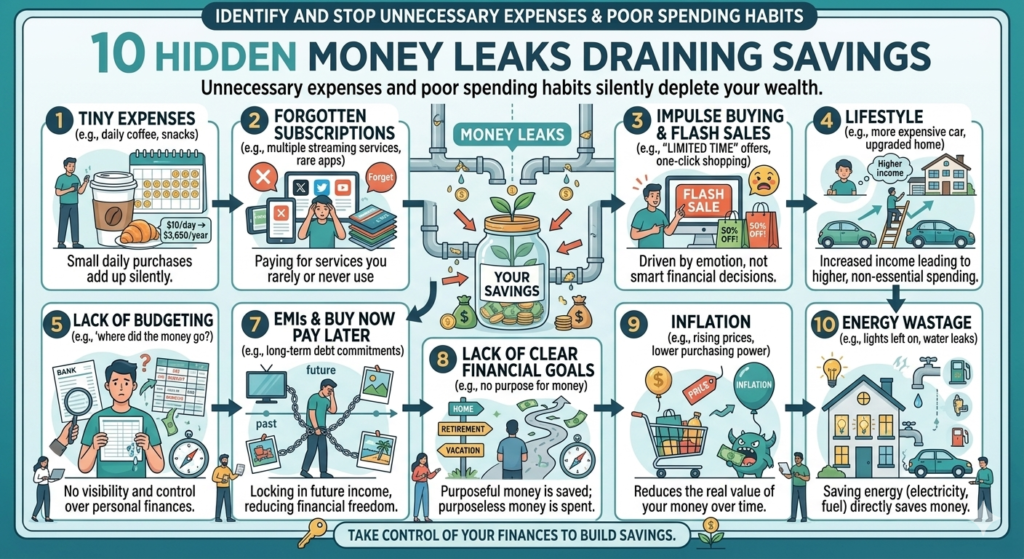
Small Choices. Stronger Finances.
📌 A Thought to Remember
“Wealth isn’t built only by earning more. It’s built by keeping more of what you already earn.”
1. The Daily “It’s Just ₹100” Habit
Imagine buying a cup of coffee on your way to work. It costs around ₹100. It doesn’t feel like much.
Now imagine making that same purchase almost every working day for a year.
That “small” expense has quietly become a surprisingly large one.
The problem isn’t the coffee.
It’s the habit.
☕ Why It Happens
Most money leaks don’t come from expensive purchases—they come from small, everyday spending that feels insignificant in the moment.
- A coffee.
- A snack.
- A bottled drink.
- An online delivery fee.
- A quick impulse purchase at the checkout.
Each expense seems harmless on its own. But because these purchases happen repeatedly, they can quietly become one of the biggest obstacles to building savings.
👤 Real-Life Example
Rahul buys coffee and a snack on his way to work for around ₹120 every weekday.
Because it’s part of his daily routine, he barely notices the cost.
By the end of the year, however, he has spent more than ₹30,000—money that could have gone toward an emergency fund, a vacation, or long-term investments.
The individual purchase wasn’t expensive.
The repeated habit was.
💡 Did You Know?
Spending ₹100 every day adds up to approximately:
• ₹3,000 every month
• ₹36,000 every year
That’s before considering the potential returns if the money had been saved or invested.
🚨 Why It Matters
Small purchases rarely feel expensive because they’re spread across days, weeks, and months. That makes them easy to overlook—but together, they can quietly consume a meaningful portion of your income.
The goal isn’t to stop enjoying life’s little pleasures. It’s to make sure they’re intentional rather than automatic.
✅ How to Plug This Money Leak
✔ Set a daily or weekly discretionary spending limit.
✔ Prepare coffee, snacks, or meals at home when practical.
✔ Use cash or a separate UPI wallet/account for discretionary spending.
✔ Review your small transactions once a week.
✔ Treat recurring daily spending like a subscription—if it’s not adding enough value, rethink the habit.
⚠️ Common Mistakes
❌ Thinking, “It’s only ₹100.”
❌ Ignoring small UPI or card transactions.
❌ Spending out of habit instead of genuine need.
❌ Never reviewing recurring micro-expenses.
💧 Leak Meter
Impact: ★★★★★ (Very High)
Potential Annual Savings: Up to ₹36,000 or more, depending on your habits
Difficulty to Fix: ⭐⭐⭐☆☆
Time to Start: 5 minutes
⚡ Quick Action
Open your banking or UPI app and review your transactions from the past seven days.
Count how many small discretionary purchases you’ve made.
If you notice a recurring pattern, challenge yourself to skip just one of those purchases this week and move that money into your savings instead.
🎯 Key Takeaway
Small expenses rarely damage your finances on their own.
It’s the repeated habit—not the individual purchase—that quietly drains your savings.
💬 Money Wisdom
“Small expenses don’t become expensive overnight. They become expensive because they’re repeated day after day.”
2. Subscriptions You Forgot About
Have you ever checked your bank statement and noticed a subscription you completely forgot about?
A streaming platform.
A music app.
Cloud storage.
A fitness membership.
A premium AI tool.
If you’ve ever thought, “I didn’t even know I was still paying for this,” you’re not alone.
Unlike one-time purchases, subscriptions quietly renew month after month, making them one of the easiest ways money slips out of your account unnoticed.
📺 Why It Happens
Subscriptions are designed to be convenient.
Once you enable auto-renewal, payments happen automatically in the background. Because each charge is usually small, it rarely attracts attention.
One subscription may not seem expensive.
But several subscriptions—especially those you rarely use—can quietly become a significant annual expense.
The danger isn’t the monthly cost.
It’s paying for something that no longer adds value to your life.
👤 Real-Life Example
Priya signs up for a streaming service to watch one series.
Later, she subscribes to a music app, cloud storage, a fitness platform, and a premium AI tool.
Each service costs between ₹199 and ₹299 a month.
Individually, the charges seem insignificant.
Months later, she realizes she’s spending nearly ₹1,000 every month on services she barely uses.
That’s around ₹12,000 a year disappearing through automatic renewals.
💡 Did You Know?
Five subscriptions costing ₹199 each per month add up to nearly ₹12,000 a year.
That’s enough to build an emergency fund, pay for a vacation, or invest toward a long-term financial goal.
🚨 Why It Matters
Recurring payments are easy to overlook because they don’t require a buying decision each month.
When a service no longer provides value, every renewal quietly reduces the money available for your financial goals.
✅ How to Plug This Money Leak
✔ Review your subscriptions at least once a month.
✔ Cancel services you haven’t used in the past 30 days.
✔ Turn off auto-renewal whenever practical.
✔ Use legitimate family or bundled plans where appropriate.
✔ Set reminders before annual renewals.
✔ Before renewing, ask yourself: “If I didn’t already have this subscription, would I pay for it today?”
⚠️ Common Mistakes
❌ Forgetting to cancel free trials before they convert into paid plans.
❌ Paying separately for services that offer family or bundled plans.
❌ Keeping subscriptions “just in case.”
❌ Never reviewing recurring payments on bank or credit card statements.
💧 Leak Meter
Impact: ★★★★☆ (High)
Potential Annual Savings: ₹5,000–₹15,000+ (depending on the number of subscriptions)
Difficulty to Fix: ⭐⭐☆☆☆
Time to Start: 10 minutes
⚡ Quick Action
Open your bank, credit card, or UPI statement.
Highlight every recurring payment made over the past three months.
If you find a subscription you haven’t used recently, cancel it today—or set a reminder to review it before the next renewal.
🎯 Key Takeaway
Subscriptions should earn their place in your budget every month.
If a service no longer provides enough value, stop paying for it and redirect that money toward your financial goals.
💬 Money Wisdom
“The easiest money to save is the money you stop paying for something you no longer use.”
3. Impulse Buying & Flash Sales
“Only 2 Items Left.”
“Sale Ends Tonight.”
“Limited-Time Offer.”
These messages aren’t just advertisements—they’re designed to make you buy before you have time to think.
The goal isn’t simply to sell a product.
It’s to create a sense of urgency that makes spending feel like a smart decision.
🛍️ Why It Happens
Retailers use psychological triggers such as scarcity, urgency, and fear of missing out (FOMO) to encourage quick purchases.
When we believe an opportunity is about to disappear, we tend to focus on the discount instead of asking a more important question:
“Do I actually need this?”
Instead of making a planned purchase, we make an emotional one.
The result is spending more than we intended—often on things we didn’t plan to buy in the first place.
👤 Real-Life Example
Anita opens her favourite shopping app to buy a ₹300 phone charger.
Before checking out, she sees an offer:
“Buy 3, Save 40%.”
She adds a phone case, earphones, and a power bank to qualify for the discount.
Her final bill is ₹2,200.
She feels like she saved money because she received a discount.
In reality, she spent ₹1,900 more than she originally intended.
💡 Did You Know?
The biggest saving often isn’t finding a better discount.
It’s deciding not to buy something you didn’t need in the first place.
Every purchase you avoid is a 100% saving on that expense.
🚨 Why It Matters
Impulse purchases usually don’t feel expensive because each one seems justified.
But repeated emotional spending can quietly reduce the money available for your emergency fund, investments, and long-term financial goals.
A good deal isn’t valuable if it encourages unnecessary spending.
✅ How to Plug This Money Leak
✔ Follow the 24-hour rule before buying non-essential items. It means waiting at least one full day before making a purchase that is not a necessity. This pause helps reduce impulse buying by giving you time to think about whether you truly need the item, whether it fits your budget, and if it will still be valuable after the initial excitement wears off. In many cases, people realize they no longer want the item after waiting, which helps save money and encourages more thoughtful spending habits. The 24-hour rule is a simple yet effective strategy for making smarter financial decisions and avoiding unnecessary expenses.
✔ For expensive purchases, use the 7-day rule to give yourself time to think.
✔ Leave items in your cart and come back later.
✔ Remove saved payment methods to reduce one-click buying.
✔ Shop with a list and stick to it.
✔ Before purchasing, ask yourself:
“Would I still buy this if it weren’t on sale?”
⚠️ Common Mistakes
❌ Shopping because you’re bored or stressed.
❌ Buying extra items just to qualify for free shipping.
❌ Mistaking a discount for genuine savings.
❌ Shopping without a list or budget.
❌ Allowing flash-sale countdowns to pressure your decisions.
💧 Leak Meter
Impact: ★★★★★ (Very High)
Potential Annual Savings: ₹10,000–₹50,000+ (depending on spending habits)
Difficulty to Fix: ⭐⭐⭐⭐☆
Time to Start: Today
⚡ Quick Action
Open your favourite shopping app.
Move every non-essential item from your cart to Wishlist or Save for Later.
Wait at least 24 hours before deciding whether to buy it.
If you still want it after the waiting period—and it fits your budget—it may be a more thoughtful purchase.
🎯 Key Takeaway
The most effective way to save money isn’t always finding a better deal.
It’s creating enough time between wanting something and buying it to make a thoughtful decision.
💬 Money Wisdom
“A discount doesn’t save you money if it persuades you to buy something you didn’t need.”
4. Lifestyle Inflation (The Silent Wealth Killer)
A salary hike feels rewarding.
After months—or even years—of hard work, a promotion, bonus, or pay raise is something worth celebrating.
But what often happens next?
A better smartphone.
A bigger car.
More meals at restaurants.
Premium subscriptions.
Costlier vacations.
Gradually, the lifestyle that once felt like a luxury becomes your new normal.
Before long, you’re earning more—but you’re not saving more.
That’s lifestyle inflation.
📈 Why It Happens
As our income grows, our spending often grows with it.
This is known as lifestyle inflation—the tendency to increase spending as earnings increase.
It usually doesn’t happen overnight. Instead, it happens through a series of small upgrades that each seem reasonable on their own.
You tell yourself: “I’ve worked hard. I deserve this.”
And often, that’s true.
The problem isn’t enjoying the rewards of your hard work.
The problem is when every increase in income is immediately absorbed by higher spending, leaving little or nothing for savings and investments.
A higher income should improve your financial future—not just your monthly expenses.
👤 Real-Life Example
Arjun receives a salary increase of ₹20,000 per month. He plans to save most of it.
Over the next few months, however, he:
- Upgrades his phone on EMI.
- Starts ordering food more often.
- Switches to premium subscriptions.
- Takes more expensive vacations.
- Moves into a more expensive lifestyle.
A year later, his salary is higher, but his savings have barely changed.
The extra ₹20,000 didn’t disappear. It was gradually absorbed by lifestyle upgrades.
His income increased. His wealth didn’t.
💡 Did You Know?
One of the simplest ways to build long-term wealth is to save or invest part of every salary increase.
For example, if you invest even 50% of every raise, you can enjoy a better lifestyle while steadily increasing your savings and investments.
Small decisions made each time your income grows can have a significant impact over the long run.
🚨 Why It Matters
Lifestyle inflation is dangerous because it doesn’t feel like overspending.
Each upgrade seems affordable. Each expense appears justified.
But when spending rises as quickly as income, your financial position stays largely the same.
You work harder. You earn more.
Yet your long-term financial goals remain unchanged.
✅ How to Plug This Money Leak
✔ Save or invest a fixed percentage of every salary increase, bonus, or unexpected income.
✔ Wait a few months before making major lifestyle upgrades after a pay raise.
✔ Automate investments before increasing discretionary spending.
✔ Upgrade only the things that genuinely improve your quality of life.
✔ Build assets before expanding your lifestyle.
✔ Celebrate higher savings and investments—not just higher spending.
⚠️ Common Mistakes
❌ Increasing expenses immediately after receiving a raise.
❌ Assuming a higher income automatically leads to financial security.
❌ Upgrading multiple aspects of your lifestyle at the same time.
❌ Comparing your lifestyle with friends, colleagues, or social media.
❌ Treating every bonus or pay raise as money to spend.
💧 Leak Meter
Impact: ★★★★★ (Very High)
Potential Annual Savings: ₹50,000+ over time (depending on income growth and spending habits)
Difficulty to Fix: ⭐⭐⭐⭐☆
Time to Start: With your next salary increase
⚡ Quick Action
Think about your most recent salary increase, bonus, or additional source of income.
Ask yourself:
- How much went toward savings?
- How much was invested?
- How much was used to repay debt?
- How much funded lifestyle upgrades?
If most of the increase went toward spending, decide today that your next pay raise will increase your savings rate before it increases your lifestyle.
🎯 Key Takeaway
Earning more doesn’t automatically make you wealthier.
Wealth grows when your savings and investments increase faster than your spending.
💬 Money Wisdom
“A higher income can improve your lifestyle. A higher savings rate can improve your future.”
5. No Budget = No Control
Imagine driving a car without a speedometer, fuel gauge, or navigation.
You might still reach your destination.
But you wouldn’t know:
- How fast you’re going.
- How much fuel you have left.
- Whether you’re heading in the right direction.
Managing money without a budget works the same way.
Many people earn a good income yet still wonder: “Where did all my money go this month?”
The problem often isn’t a lack of income. It’s a lack of visibility.
📊 Why It Happens
Many people think budgeting means restricting every expense or giving up the things they enjoy.
In reality, a budget isn’t about saying “no” to spending. It’s about deciding where your money should go before it’s spent.
Without a budget, spending happens on autopilot.
A few food deliveries. A few online purchases. A few subscriptions. A few convenience expenses.
None of them seem significant on their own. But together, they can quietly consume a large portion of your income before you realize it.
A budget replaces guesswork with clarity, helping you spend intentionally instead of reactively.
👤 Real-Life Example
Meera earns ₹60,000 a month and pays all her bills on time.
She believes she’s managing her money well because she rarely misses a payment.
But she never tracks her spending.
At the end of each month, she discovers she has spent:
- Around ₹5,000 on food delivery.
- Nearly ₹3,000 on online shopping.
- About ₹2,000 on subscriptions and entertainment.
- Several hundred rupees on small UPI payments she doesn’t even remember making.
No single expense was excessive. But together, they quietly consumed more than ₹10,000.
The issue wasn’t overspending on one thing. It was never seeing the full picture.
💡 Did You Know?
Most people remember large purchases but underestimate how much they spend on small, frequent transactions.
Tracking your expenses for just 30 days can reveal spending patterns and money leaks you may never have noticed.
Awareness is often the first step toward better financial decisions.
🚨 Why It Matters
Without a budget, it’s difficult to know whether your money is supporting your priorities or disappearing into everyday spending.
When you don’t decide where your money should go, your daily habits make that decision for you.
A budget gives every rupee a purpose.
✅ How to Plug This Money Leak
✔ Choose a simple budgeting method that you can stick to, such as the 50–30–20 Rule:
- 50% – Needs (housing, groceries, utilities, transportation)
- 30% – Wants (entertainment, dining out, hobbies)
- 20% – Savings, investments, and debt repayment
✔ Review your expenses every week instead of waiting until month-end.
✔ Use a budgeting app, spreadsheet, or notebook—whatever you’ll use consistently.
✔ Set spending limits for categories where you tend to overspend.
✔ Review your budget regularly and adjust it as your income or expenses change.
⚠️ Common Mistakes
❌ Creating a budget once and never updating it.
❌ Making a budget that’s too restrictive to follow.
❌ Tracking only large expenses while ignoring everyday purchases.
❌ Assuming budgeting is only for people with low incomes.
❌ Saving only if money is left over at the end of the month.
💧 Leak Meter
Impact: ★★★★☆ (High)
Potential Annual Savings: ₹5,000–₹50,000+ (depending on your spending habits)
Difficulty to Fix: ⭐⭐⭐☆☆
Time to Start: 30 minutes
⚡ Quick Action
Open your banking or UPI app and review the last 30 days of transactions.
Create three simple categories:
☐ Essential expenses
☐ Lifestyle spending
☐ Unnecessary spending
Don’t try to change anything yet. Simply observe where your money is going.
You can’t improve what you don’t measure.
🎯 Key Takeaway
A budget doesn’t limit your freedom—it gives you control.
When you know where your money is going, you can make deliberate choices that support your goals instead of wondering where your income disappeared.
💬 Money Wisdom
“A budget doesn’t limit your money—it gives it direction. It doesn’t create wealth, but it shows where your money should go and reveals where your wealth is quietly slipping away.”
6. Hidden Charges & Fees
Not every money leak comes from something you choose to buy. Sometimes, money disappears through charges you barely notice.
- A ₹20 ATM fee.
- A ₹100 late payment penalty.
- A convenience fee during an online booking.
- A delivery charge on a food order.
Individually, these amounts seem too small to matter. But over time, they can quietly add up to thousands of rupees.
The difference is that, unlike a purchase, these charges often provide little or no value in return.
💸 Why It Happens
Most people compare product prices carefully but pay far less attention to the extra charges attached to them.
These may include:
- Convenience fees
- Delivery charges
- Processing fees
- ATM charges
- Annual card fees
- Late payment penalties
- Platform or service fees
Because these costs are usually small and appear separately, they’re easy to ignore.
Over time, however, repeated fees can quietly reduce your savings without improving your lifestyle.
Convenience has a cost—but many of these costs are avoidable.
👤 Real-Life Example
Vikram frequently orders food online because it’s quick and convenient.
The menu prices seem reasonable, but each order also includes:
- Delivery charges
- Platform fees
- Packaging charges
- Surge pricing
Occasionally, he also misses a credit card payment and incurs a late payment fee.
None of these charges feels significant on its own.
By the end of the year, however, he has spent several thousand rupees on fees that added little value to his life.
The money didn’t buy anything meaningful. It simply disappeared through avoidable charges.
💡 Did You Know?
Losing just ₹500 a month to avoidable fees adds up to ₹6,000 a year.
That’s before considering what the money could have earned if it had been saved or invested.
Small charges become expensive when they’re repeated.
🚨 Why It Matters
Hidden charges are easy to overlook because they don’t feel like normal spending.
They’re often accepted as part of the transaction instead of questioned.
But every avoidable fee is money that could have gone toward your savings, investments, or financial goals.
✅ How to Plug This Money Leak
✔ Pay bills before the due date to avoid late payment charges.
✔ Set payment reminders or enable automatic payments where appropriate.
✔ Review your bank and credit card statements every month.
✔ Plan ahead to reduce unnecessary delivery and convenience fees.
✔ Use your own bank’s ATM network whenever possible.
✔ Check the final payment amount before confirming an online purchase.
✔ Review annual bank account and credit card charges to ensure they’re still worth paying.
⚠️ Common Mistakes
❌ Ignoring small fees because they’re “only ₹20 or ₹50.”
❌ Paying late fees repeatedly instead of setting reminders.
❌ Keeping bank accounts or credit cards with charges you don’t benefit from.
❌ Choosing convenience every time without considering the extra cost.
❌ Never reviewing monthly statements for unnecessary charges.
💧 Leak Meter
Impact: ★★★☆☆ (Medium)
Potential Annual Savings: ₹2,000–₹10,000+ (depending on your spending habits)
Difficulty to Fix: ⭐⭐☆☆☆
Time to Start: 15 minutes
⚡ Quick Action
Open your latest bank or credit card statement.
Look for entries such as:
☐ Fee
☐ Charge
☐ Penalty
☐ Renewal
☐ Convenience
Identify one recurring or avoidable charge and take action to eliminate it before your next billing cycle.
🎯 Key Takeaway
Hidden fees rarely damage your finances because they’re large. They do it because they’re small, frequent, and easy to ignore.
Reviewing your statements regularly can help you keep more of the money you already earn.
💬 Money Wisdom
“A fee you don’t notice still costs you money. Paying attention is the first step toward eliminating unnecessary charges. A rupee wasted through a fee is still a rupee that could have worked toward your future.”
7. Buy Now, Pay Later (BNPL) & EMI Trap
“Only ₹999 per month.”
It sounds affordable.
A new smartphone. A premium laptop. A designer watch. A vacation package.
When the total cost is divided into small monthly payments, expensive purchases suddenly feel much easier to justify.
And that’s exactly where the trap begins.
The question quietly changes from:
“Can I afford this?”
to
“Can I afford the monthly payment?”
Those are not the same thing.
💳 Why It Happens
Buy Now, Pay Later (BNPL) services and EMI options change the way we think about spending.
Instead of focusing on the total price, we focus on the monthly installment.
For example, a ₹60,000 smartphone may seem expensive. But ₹2,500 per month feels manageable.
One EMI may not create a problem. The risk begins when multiple monthly commitments start stacking up.
A phone.
A laptop.
Furniture.
Home appliances.
Online shopping.
Streaming subscriptions.
Individually, each payment seems affordable.
Together, they can consume a significant portion of your monthly income before your salary even arrives.
The issue isn’t the EMI itself. It’s losing track of how much of your future income is already committed.
👤 Real-Life Example
Rahul buys a smartphone on EMI for ₹2,500 a month.
A few weeks later, he purchases a laptop on EMI.
Then he uses BNPL to buy furniture and pays for a few online purchases in installments.
None of the monthly payments feels overwhelming.
But together, they add up to nearly ₹10,000 every month.
Before he receives his salary, a part of it is already spoken for.
That leaves him with less flexibility to:
- Build an emergency fund.
- Invest for the future.
- Handle unexpected expenses.
- Achieve other financial goals.
💡 Did You Know?
A purchase can feel affordable simply because the payment is spread over several months.
Before choosing EMI or BNPL, ask yourself:
“Would I still buy this if I had to pay the full amount today?”
If the answer is no, it’s worth reconsidering whether the purchase is truly necessary.
🚨 Why It Matters
EMIs and BNPL don’t reduce the price of a purchase. They simply spread the cost over time.
When too much of your future income is committed, you have less flexibility to save, invest, or deal with unexpected expenses.
Financial freedom isn’t just about how much you earn. It’s also about how much of your income remains available after your monthly commitments.
✅ How to Plug This Money Leak
✔ Use EMIs mainly for planned purchases that provide long-term value.
✔ Avoid BNPL for impulse purchases, fashion, or short-lived lifestyle upgrades.
✔ Calculate the total cost, not just the monthly installment.
✔ Keep your total EMI commitments within a comfortable share of your monthly income.
✔ Save first and buy later whenever possible for non-essential purchases.
✔ Before choosing EMI, ask: “Is this purchase worth committing my future income?”
⚠️ Common Mistakes
❌ Looking only at the monthly payment instead of the total cost.
❌ Taking multiple “No-Cost EMI” offers without tracking them.
❌ Using BNPL for everyday shopping or impulse purchases.
❌ Buying a more expensive product because financing makes it seem affordable.
❌ Treating available credit as extra income.
💧 Leak Meter
Impact: ★★★★★ (Very High)
Potential Annual Savings: ₹10,000–₹50,000+ (depending on borrowing and spending habits)
Difficulty to Fix: ⭐⭐⭐⭐☆
Time to Start: Before your next financed purchase
⚡ Quick Action
Take two minutes to list all your current:
☐ EMIs
☐ BNPL payments
☐ Credit card installment plans
Add up the monthly total.
Now ask yourself:
“How much of my next salary is already committed before I receive it?”
If the answer surprises you, reducing these commitments should become one of your next financial priorities.
🎯 Key Takeaway
EMIs and BNPL can make expensive purchases feel affordable.
They don’t make those purchases cheaper.
Use them thoughtfully, and only when they support a well-planned financial decision—not an impulsive one.
💬 Money Wisdom
EMIs are not always bad, but using them for lifestyle purchases without planning can become a financial leak.
“Every EMI is a promise made to your future income. Choose carefully what deserves that commitment.”
8. No Clear Financial Goals
Imagine getting into a car and starting to drive without knowing where you want to go.
You may enjoy the journey. You may keep moving. But after hours of driving, you may still end up nowhere.
Money works the same way.
When you don’t have a clear financial destination, your money usually follows the easiest path: Daily expenses. Convenience purchases. Entertainment. Short-term wants.
Without a purpose, money gets spent.
With a purpose, money gets protected, saved, and invested.
🎯 Why It Happens
Many people believe that simply saving money is the goal. But saving without a clear purpose can be difficult to maintain.
Why?
Because there is no emotional connection behind the decision.
Saving ₹10,000 may feel like a sacrifice when you don’t know why you are saving it.
But saving ₹10,000 toward:
- An emergency fund.
- A home purchase.
- Financial independence.
- Your child’s education.
- A dream vacation.
feels completely different.
A goal gives your money direction. It transforms saving from something you have to do into something you want to achieve.
👤 Real-Life Example
Amit earns a good salary and saves some money every month. However, he has no specific financial goals.
Whenever an opportunity appears:
- A new gadget.
- A shopping sale.
- A vacation offer.
- A lifestyle upgrade.
he uses his savings because there is no clear reason to protect that money.
Meanwhile, his friend Neha has defined goals:
- Build a ₹5 lakh emergency fund.
- Save for a home down payment.
- Invest for retirement.
Because her money has a purpose, she finds it easier to avoid unnecessary spending.
The difference isn’t income.
It’s direction.
💡 Did You Know?
People are often more consistent with saving when they connect money to a specific goal rather than an abstract idea like “saving more.”
Clear financial goals create:
✅ Motivation
✅ Accountability
✅ A measurable target
✅ A reason to delay unnecessary spending
A goal turns saving from a vague intention into a planned action.
🚨 Why It Matters
Without financial goals, short-term desires often compete with long-term priorities.
When money has no assigned purpose, the latest opportunity, sale, or temptation can easily take priority.
A clear goal acts like a financial filter—it helps you decide what deserves your money and what does not.
✅ How to Plug This Money Leak
✔ Define your short-term, medium-term, and long-term financial goals.
Short-Term Goals (0–2 years)
- Emergency fund
- Debt repayment
- Vacation planning
Medium-Term Goals (2–5 years)
- Vehicle purchase
- Higher education
- Home down payment
Long-Term Goals (5+ years)
- Retirement planning
- Wealth creation
- Financial independence
✔ Assign a specific amount and deadline to every goal.
✔ Automate savings toward important goals.
✔ Review your progress regularly.
✔ Celebrate milestones instead of waiting only for the final target.
⚠️ Common Mistakes
❌ Saving money without knowing what it is meant for.
❌ Keeping all savings in one account without purpose.
❌ Changing goals frequently based on short-term desires.
❌ Waiting for “extra money” before working toward goals.
❌ Copying someone else’s financial goals instead of defining your own.
💧 Leak Meter
Impact: ★★★★☆ (High)
Potential Annual Savings: ₹10,000–₹1,00,000+ (depending on income and habits)
Difficulty to Fix: ⭐⭐⭐☆☆
Time to Start: 20 minutes
⚡ Quick Action
Take a notebook or open your notes app.
Write down one financial goal you want to achieve within the next 12 months.
Then answer:
☐ How much money do I need?
☐ By when do I need it?
☐ How much should I save every month?
Remember: A goal without a number is just a wish. A number with a plan becomes a target.
🎯 Key Takeaway
Money without direction gets spent. Money with a purpose gets protected, saved, and grown.
Clear financial goals make it easier to say no to unnecessary spending and yes to the things that truly matter.
💬 Money Wisdom
“When your money has a mission, saying no to distractions becomes much easier.”
9. Inflation: The Invisible Leak
Imagine keeping ₹1,00,000 safely in your bank account for many years. The number on your statement remains the same. Your money is still there.
But when you finally use it, you discover something surprising: It cannot buy what it used to.
The money did not disappear. Its purchasing power reduced.
That is inflation—the invisible leak that slowly reduces the value of your money over time.
🔥 Why It Happens
Inflation means the prices of goods and services increase over time.
A meal that costs ₹200 today may cost much more in the future.
A home that costs ₹50 lakh today may require a significantly higher amount years later.
A retirement plan that seems sufficient today may not support the same lifestyle decades from now.
The challenge with inflation is that it does not feel like money leaving your account.
There is:
❌ No transaction
❌ No bill
❌ No payment notification
But slowly, your money buys fewer things than before.
Your account balance may look safe. Your financial future may still be losing value.
👤 Real-Life Example
Ten years ago, ₹100 could buy significantly more than it can today.
A family spending ₹40,000 per month today may need much more in the future to maintain a similar lifestyle.
Now imagine someone keeping all their long-term savings in an option that grows slower than rising prices.
The account balance may increase slightly. But if inflation grows faster, the real value of that money decreases.
The money grows in numbers. But it loses strength in reality.
💡 Did You Know?
Inflation can have a powerful impact over long periods.
For example: If prices increase by an average of 6% per year, something costing ₹1,00,000 today could cost approximately ₹1,79,000 after 10 years.
This is why long-term financial planning is not only about asking: “How much money will I have?”
It is also about asking: “What will that money be able to buy in the future?”
🚨 Why It Matters
Many people focus only on protecting their money but forget that money also needs to maintain its purchasing power.
Keeping money safe is important for short-term needs.
But for long-term goals, your financial plan should also consider growth.
The goal is not simply to have more money.
The goal is to ensure your money continues to support your future lifestyle.
✅ How to Protect Yourself From This Money Leak
✔ Keep emergency funds and short-term money in safe and accessible options.
✔ For long-term goals, consider investment options suitable for your goals and risk profile.
✔ Review your investments periodically.
✔ Increase your earning potential through skills, career growth, or additional income sources.
✔ Avoid keeping large amounts of long-term money completely idle.
✔ Understand the difference:
Saving money = Protecting your money today
Investing wisely = Helping your money grow for tomorrow
⚠️ Common Mistakes
❌ Keeping all long-term savings in low-growth options.
❌ Ignoring inflation while planning retirement.
❌ Assuming today’s money value will remain the same forever.
❌ Focusing only on saving and never learning about investing.
❌ Delaying investment decisions because the amount feels too small.
💧 Leak Meter
Impact: ★★★★☆ (High)
Potential Annual Savings: Protects long-term purchasing power
Difficulty to Fix: ⭐⭐⭐⭐☆
Time to Start: During your next financial review
⚡ Quick Action
Think about your biggest long-term financial goal:
☐ Buying a home
☐ Retirement planning
☐ Child’s education
☐ Financial independence
Now ask yourself:
“Will the money I am saving today still be enough when I reach this goal?”
If you are unsure, inflation needs to become part of your financial planning.
🎯 Key Takeaway
Inflation does not reduce the number in your bank account. It reduces what that money can buy.
Building wealth requires not only saving money but also planning for how that money will grow over time.
You cannot control inflation. But you can control how you prepare for it.
💬 Money Wisdom
“Money that stays still may look safe, but over time, inflation quietly reduces its power.”
10. Energy Leaks: Wasting Electricity & Fuel Every Day
Not every money leak appears in your shopping history.
- Some appear quietly in your electricity bill.
- Some disappear from your fuel tank.
- A fan running in an empty room.
- Lights left switched on during the day.
- A television playing when nobody is watching.
- A vehicle engine running while waiting.
Each action may seem too small to matter. But repeated every day, these small habits can quietly increase your monthly expenses.
These are energy leaks—unnecessary costs that reduce your money without adding real value to your life.
⚡ Why It Happens
Energy waste usually happens because convenience takes priority over awareness.
Unlike shopping, energy wastage does not feel like spending money.
You do not immediately see:
- The cost of leaving lights on.
- The fuel wasted during unnecessary idling.
- The electricity used by unused appliances.
- The extra consumption caused by inefficient habits.
Because there is no immediate financial impact, these habits often continue unnoticed.
But small amounts of waste repeated over hundreds of days can become a meaningful expense.
Saving energy is not only good for the environment. It is also a simple way to keep more money in your pocket.
👤 Real-Life Example
Suresh leaves home every morning without checking his electricity usage.
A fan continues running in an empty room. Lights remain switched on in unused areas. The television stays on standby. During daily travel, he also keeps his vehicle engine running during unnecessary waiting periods.
Each incident feels insignificant.
But over time, these habits contribute to:
- Higher electricity bills.
- Increased fuel consumption.
- More frequent fuel expenses.
The money is not being spent on something valuable. It is simply lost through waste.
💡 Did You Know?
Small efficiency improvements can create meaningful savings over time.
Simple habits include:
✔ Switching off unused lights and fans.
✔ Using energy-efficient appliances ↗.
✔ Avoiding unnecessary vehicle idling.
✔ Maintaining proper tyre pressure for better mileage.
✔ Monitoring electricity usage patterns.
The key is not one big change. It is repeating small improvements consistently.
🚨 Why It Matters
Energy leaks are difficult to notice because they happen gradually.
A person may carefully track shopping expenses while ignoring the money lost through unnecessary electricity and fuel usage.
The result?
Higher monthly expenses without any improvement in comfort or lifestyle.
Reducing waste is one of the easiest ways to improve your finances because it does not require giving up things that genuinely matter.
✅ How to Plug This Money Leak
✔ Switch off lights, fans, and appliances when leaving a room.
✔ Use natural daylight whenever possible.
✔ Replace old bulbs with energy-efficient LED lights.
✔ Avoid leaving chargers and devices plugged in unnecessarily.
✔ Turn off your vehicle engine during longer stops where appropriate and safe.
✔ Maintain your vehicle regularly for better fuel efficiency.
✔ Keep tyres properly inflated to improve mileage.
✔ Review electricity bills regularly to identify unusual increases.
⚠️ Common Mistakes
❌ Leaving lights or fans on because “it is only for a few minutes.”
❌ Keeping appliances on standby all day.
❌ Ignoring fuel wastage during unnecessary idling.
❌ Assuming electricity and fuel bills cannot be reduced.
❌ Choosing convenience every time without considering the long-term cost.
💧 Leak Meter
Impact: ★★★☆☆ (Medium)
Potential Annual Savings: ₹3,000–₹15,000+
Difficulty to Fix: ⭐☆☆☆☆
Time to Start: Today
⚡ Quick Action
Take a 5-minute energy audit of your home and vehicle.
Check:
☐ Are any lights on in empty rooms?
☐ Are fans running unnecessarily?
☐ Are unused chargers plugged in?
☐ Are appliances left on standby?
☐ Do you keep your vehicle running during unnecessary stops?
Choose one habit to change today.
Small savings repeated daily become meaningful savings over time.
🎯 Key Takeaway
Saving money is not only about earning more or investing better.
It is also about reducing what you waste.
Every unit of electricity saved and every drop of fuel conserved is money that stays available for your goals.
💬 Money Wisdom
“Every unit of energy and every drop of fuel you save is money you keep working for your future.”
Plug the Leaks Action Plan: Take Control of Your Money
By now, one thing should be clear: Your money usually does not disappear because of one major financial mistake.
It disappears through small, repeated decisions that seem harmless in the moment.
- A daily coffee.
- An unused subscription.
- An impulse purchase.
- An unnecessary fee.
- An EMI commitment.
- A missed financial goal.
- A light left switched on.
- A vehicle burning fuel while standing still.
Individually, these choices may seem insignificant.
But together, they can quietly reduce your ability to save, invest, and build the future you want.
The good news?
You do not need to fix everything overnight.
You simply need to identify the biggest leaks, take small actions, and build better money habits one step at a time.
🚀 Step 1: Discover Where Your Money Is Going
Before you can fix a leak, you need to find it. Many people try to save more without understanding where their money is already going.
The first step is awareness.
For the next 30 days:
✔ Track every expense.
✔ Review your bank and UPI transactions.
✔ Identify recurring payments.
✔ Notice spending patterns.
✔ Separate needs from wants.
You are not trying to judge your spending. You are trying to understand it.
Remember: What you measure, you can manage.
✅ Step 2: Fix the Easy Wins First
Not every money leak requires a major lifestyle change. Some can be fixed within minutes.
Start with simple actions:
✔ Cancel subscriptions you no longer use.
✔ Remove unnecessary recurring payments.
✔ Avoid avoidable fees and penalties.
✔ Reduce electricity and fuel waste.
✔ Pause before making impulse purchases.
These quick wins create immediate results.
More importantly, they build confidence that small changes can improve your finances.
🎯 Step 3: Control Your Spending Habits
The goal is not to remove enjoyment from your life. Money is meant to support your needs, experiences, and priorities. The goal is to spend intentionally.
Before making a purchase, ask yourself: “Does this expense move me closer to my goals or further away from them?”
This simple question creates a pause between wanting something and spending money on it.
Over time, better decisions become automatic habits.
💰 Step 4: Give Every Rupee a Purpose
Money without direction disappears. Money with a purpose gets protected.
Create clear financial goals:
🎯 Emergency fund
🎯 Debt freedom
🎯 Home purchase
🎯 Retirement planning
🎯 Wealth creation
Then give each goal:
✔ A target amount.
✔ A timeline.
✔ A monthly saving plan.
When your money has a mission, unnecessary spending becomes easier to avoid.
📈 Step 5: Make Your Money Work
Stopping leaks is the first step. But long-term financial progress requires more than saving.
Once your financial foundation is stronger:
✔ Build an emergency fund.
✔ Invest according to your goals and risk profile.
✔ Continue improving your financial knowledge.
✔ Increase your earning potential through skills and opportunities.
Remember: Saving helps protect your money. Investing helps your money grow.
⚡ Your 7-Day Money Leak Challenge
Ready to take action?
Try this simple seven-day challenge:
Day 1: Track every expense.
Day 2: Cancel one unused subscription.
Day 3: Avoid one unnecessary purchase.
Day 4: Review your bank statement for hidden charges.
Day 5: Reduce one electricity or fuel waste habit.
Day 6: Write down one financial goal.
Day 7: Move the money you saved toward that goal.
Small actions create financial momentum.
A single improvement may seem small today, but repeated habits create lasting financial change.
💧 Your Money Leak Score
How many of these leaks have you identified?
☐ Daily unnecessary spending
☐ Forgotten subscriptions
☐ Impulse purchases
☐ Lifestyle inflation
☐ No budgeting system
☐ Hidden fees
☐ Unnecessary EMIs
☐ No financial goals
☐ Inflation risk
☐ Energy waste
Your Score:
0–3 leaks identified
You have an opportunity to improve your financial awareness. Start by tracking your expenses and understanding where your money goes.
4–7 leaks identified
You have found important areas where small changes can create meaningful savings. Focus on fixing the leaks with the biggest impact first.
8–10 leaks identified
You have strong financial awareness. Now focus on creating systems that help you stay consistent.
💬 Key Money Wisdom
“Financial freedom is rarely created by one big decision. It is built by thousands of small decisions made consistently.”
Your financial journey does not change only when you earn more money. It changes when you become intentional with the money you already have.
Plug the leaks. Control the flow. Build with purpose.
Because once your money stops disappearing, it finally gets the opportunity to work for you.
📊 Money Leak Summary: Where Is Your Money Disappearing?
Your money leaks are not always obvious.
Some appear as daily habits. Some appear as financial decisions. Some are invisible forces that slowly reduce your wealth over time.
Use this quick summary to identify which areas deserve your attention first.
| 💧 Money Leak & Impact Level | Why It Hurts | First Action |
|---|---|---|
| ☕ Daily Small Spending ★★★★★ Very High | Small purchases repeated regularly can become thousands of rupees every year | Track small expenses for 7 days |
| 📺 Forgotten Subscriptions ★★★★☆ High | Automatic payments continue even when services are rarely used | Review and cancel unused subscriptions |
| 🛍️ Impulse Buying ★★★★★ Very High | Emotional purchases create unnecessary spending | Use the 24-hour waiting rule before buying |
| 📈 Lifestyle Inflation ★★★★★ Very High | Higher income gets absorbed by higher spending instead of higher savings | Save a portion of every income increase |
| 📊 No Budget ★★★★☆ High | Without visibility, spending happens automatically | Track monthly income and expenses |
| 💸 Hidden Fees ★★★☆☆ Medium | Small charges quietly reduce your savings over time | Review bank and card statements |
| 💳 BNPL & EMI Trap ★★★★★ Very High | Future income gets committed before you receive it | Avoid unnecessary installment purchases |
| 🎯 No Financial Goals ★★★★☆ High | Money without direction gets spent on short-term wants | Create specific financial targets |
| 🔥 Inflation ★★★★☆ High | Rising prices reduce the future value of your money | Plan long-term savings and investments |
| ⚡ Energy Leaks ★★★☆☆ Medium | Wasted electricity and fuel increase expenses without improving your lifestyle | Start a home and vehicle energy audit |
🎯 Where Should You Start?
You do not need to fix all 10 leaks immediately. Start with the areas that create the biggest improvement.
1. High-Impact Money Leaks
These can create the biggest difference in your financial life:
🔥 Daily unnecessary spending
🔥 Lifestyle inflation
🔥 Impulse buying
🔥 Unplanned EMIs and BNPL usage
These leaks often have the greatest long-term impact because they affect your regular cash flow.
2. Easy Wins
These can often be fixed quickly:
✅ Forgotten subscriptions
✅ Hidden fees
✅ Energy waste
Small improvements here create immediate savings and build momentum.
3. Long-Term Wealth Builders
These protect and improve your financial future:
📈 Clear financial goals
📊 Budgeting habits
🔥 Protecting money from inflation
These may not create instant savings, but they help you make better decisions for years to come.
⚡ Quick Action
Choose one money leak from the table above.
Do not choose the easiest one. Choose the one that can create the biggest positive change in your financial life.
Take one action today. One plugged leak is the beginning of better money management.
Control Money → Protect Money → Grow Money → Build Wealth
💬 Money Wisdom
“You don’t need to control every rupee perfectly. You only need to stop the leaks that matter the most.”
💬 Final Thoughts: Take Control of Your Money
Your financial progress is not decided by one big purchase, one salary increase, or one perfect investment decision.
It is shaped by the small choices you make every day.
- The coffee you buy without thinking.
- The subscription you forgot about.
- The purchase you made because of a discount.
- The fee you ignored.
- The money you never gave a purpose.
These small decisions may seem insignificant individually, but over time, they shape your financial future.
The good news is that every money leak can be identified. Every unnecessary expense can be improved. Every better decision creates momentum.
You do not need to control every rupee perfectly. You simply need to become more intentional with the money you already earn.
Start small:
✔ Track where your money goes.
✔ Fix one unnecessary expense.
✔ Create clear financial goals.
✔ Build habits that support your future.
Because wealth is not created only by earning more.
It is created by keeping more, using wisely, and allowing your money to work toward the life you want.
💬 Final Money Wisdom
“Financial freedom begins when you stop asking where your money went and start deciding where your money should go.”
Control Money → Protect Money → Grow Money → Build Wealth
🚀 Next Step: Build Your Financial Safety Net
Stopping money leaks is the first step toward better money management.
But saving more money is only part of building financial security.
Life does not always go according to plan.
Unexpected medical expenses. A sudden job loss. Emergency repairs. Family responsibilities.
These situations can put pressure on your finances if you do not have a safety net.
That is why the next step after controlling your expenses is building an emergency fund.
An emergency fund acts as a financial cushion that helps you handle unexpected situations without depending on loans, credit cards, or withdrawing long-term investments.
In the next guide, you will learn:
✅ How much emergency savings you actually need
✅ Where to keep your emergency fund safely
✅ How to build it step by step, even with a small income
✅ Common mistakes that weaken financial security
✅ How an emergency fund protects your long-term financial goals
👉 Read Next: Emergency Fund Guide: How Much You Need & How to Build It Step by Step
Because before you grow your wealth, you need a foundation strong enough to protect it.
❓ Frequently Asked Questions (FAQs): How to Stop Money Leaks and Save More
1. Why does my money disappear every month even though I earn a decent income?
Your salary may disappear not because of one large expense, but because of many small, repeated money leaks.
Common reasons include:
→ Daily unnecessary spending
→ Forgotten subscriptions
→ Food delivery and convenience expenses
→ Impulse purchases
→ Hidden fees
→ Unplanned EMI commitments
The first step is not earning more money—it is understanding where your current money is going.
2. What are hidden money leaks?
Hidden money leaks are small expenses, habits, and financial decisions that slowly reduce your savings without you noticing.
Examples include:
→ Unused subscriptions
→ ATM and bank charges
→ Daily small purchases
→ Impulse shopping
→ Energy wastage
→ Unnecessary EMIs
Individually, these expenses may seem insignificant, but together they can have a major impact on your financial progress.
3. How can I stop wasting money every month and how to control spending?
You can reduce unnecessary spending by building awareness and better habits.
Start by:
✔ Tracking your expenses for at least 30 days
✔ Creating a simple monthly budget
✔ Canceling unused subscriptions
✔ Waiting before making non-essential purchases
✔ Reviewing bank statements regularly
✔ Setting clear financial goals
Small improvements repeated consistently can create meaningful savings over time.
4. Are small daily expenses really a big problem?
Yes. Small expenses become expensive when they are repeated regularly.
For example, A ₹100 daily habit can become ₹3,000 per month, and ₹36,000 per year.
The problem is not one small purchase. The problem is the repeated pattern.
5. How do I know where my money is going?
The easiest way is to track your spending.
Review:
✔ Bank statements
✔ UPI transactions
✔ Credit card statements
✔ Subscription payments
✔ Cash expenses
A simple 30-day review can reveal spending patterns and money leaks you may not have noticed.
6. Should I stop spending completely to save money?
No. The goal is not to eliminate all spending. The goal is to spend intentionally.
A healthy financial plan allows money for:
→ Needs
→ Wants
→ Savings
→ Investments
The purpose of budgeting is not to remove enjoyment—it is to ensure your spending supports your goals.
7. Are subscriptions really a major expense?
They can be, especially when multiple subscriptions continue for months or years without being used.
A few small monthly payments may not feel expensive individually, but together they can become thousands every year.
Review your subscriptions regularly and keep only those that provide genuine value.
8. Is buying through EMI or Buy Now, Pay Later (BNPL) a bad decision?
Not necessarily. EMIs can be useful for planned, meaningful purchases when managed responsibly.
The problem begins when EMIs are used for:
→ Impulse purchases
→ Lifestyle upgrades
→ Items that lose value quickly
Before taking an EMI, ask: “Would I still buy this if I had to pay the full amount today?”
9. How does inflation affect my savings?
Inflation reduces the purchasing power of money over time.
For example, if prices increase, the same amount of money buys fewer goods and services in the future.
This means long-term savings should consider not only protecting money but also helping it grow.
10. What is the first step I should take to improve my finances?
Start with awareness.
Take these three actions:
→ Track your expenses for the next 30 days.
→ Identify your biggest money leak.
→ Fix one unnecessary expense immediately.
You don’t need to transform your finances overnight. Small improvements repeated consistently create long-term results.
💬 Money Wisdom
“Financial improvement begins when you stop wondering where your money went and start deciding where it should go.”
⚡ Quick Action
Take 5 minutes today: Open your last 10 transactions.
Ask: “Did every rupee move me closer to my goals?”
If the answer is no, identify one expense you can improve.
📚 Glossary: Key Financial Terms Explained Simply
Understanding money becomes easier when you understand the language of money.
Here are the important financial terms used in this guide.
💧 Hidden Money Leaks
Meaning: Small expenses, habits, or financial decisions that quietly reduce your savings over time.
Examples:
- Unused subscriptions
- Daily unnecessary purchases
- Hidden fees
- Impulse buying
- Wasted electricity or fuel
Remember: A money leak may look small today, but repeated leaks can create a major financial impact.
☕ Micro Expenses
Meaning: Small, frequent expenses that seem insignificant individually but add up over time.
Examples:
- Daily coffee
- Snacks
- Small online purchases
- Convenience charges
Remember: Small expenses become large expenses when they become daily habits.
📊 Budgeting
Meaning: A plan that helps you understand where your money comes from, where it goes, and how much you can save.
A budget helps you:
- ✅ Control spending
- ✅ Plan for goals
- ✅ Avoid unnecessary expenses
- ✅ Build savings consistently
Remember: A budget is not a restriction—it is a direction for your money.
📈 Lifestyle Inflation
Meaning: The habit of increasing your spending as your income increases.
A salary increase leads to:
- More expensive purchases
- Higher lifestyle expenses
- More subscriptions
- Bigger financial commitments
Remember: A higher income creates wealth only when your savings increase along with it.
🛍️ Impulse Buying
Meaning: Buying something without planning, usually because of emotions, discounts, urgency, or marketing pressure.
Common triggers:
- Flash sales
- Limited-time offers
- Fear of missing out (FOMO)
Remember: A discount is not a saving if it makes you buy something you didn’t need.
📺 Subscription Spending
Meaning: Recurring payments made for services that renew automatically.
Examples:
- Streaming platforms
- Music apps
- Cloud storage
- Software tools
- Fitness apps
Remember: Small recurring payments can become large annual expenses.
💸 Hidden Charges & Fees
Meaning: Additional costs that are often overlooked but reduce your available money.
Examples:
- Late payment penalties
- Convenience fees
- Bank charges
- Delivery fees
- Annual card fees
Remember: Fees rarely hurt because they are large—they hurt because they are easy to ignore.
💳 EMI (Equated Monthly Installment)
Meaning: A fixed monthly payment made to repay a loan or purchase over a specific period.
Key Insight: EMIs can be useful for planned financial decisions, but excessive EMIs can reduce your monthly flexibility.
Remember: Every EMI is a commitment made against your future income.
🛒 Buy Now, Pay Later (BNPL)
Meaning: A payment option that allows you to purchase something immediately and pay later, usually in installments.
Key Insight: BNPL can feel convenient, but frequent use can encourage unnecessary spending.
Remember: Delayed payment does not mean reduced cost.
🎯 Financial Goals
Meaning: Specific money targets that give your savings a purpose.
Examples:
- Building an emergency fund
- Buying a home
- Paying off debt
- Retirement planning
- Wealth creation
Remember: Money without a goal gets spent. Money with a purpose gets protected.
🔥 Inflation
Meaning: The gradual increase in prices over time, which reduces the purchasing power of money.
Key Insight: If prices increase, the same amount of money buys fewer goods and services in the future.
Remember: Inflation does not remove money from your account—it reduces what your money can do.
💰 Purchasing Power
Meaning: The amount of goods and services your money can buy.
Key Insight: If ₹1,000 buys fewer items in the future, your purchasing power has decreased.
Remember: The value of money is measured not only by how much you have, but by what it can buy.
⚡ Energy Efficiency
Meaning: Using electricity and fuel wisely to reduce waste and lower expenses.
Examples:
- Switching off unused lights and fans
- Using efficient appliances
- Reducing unnecessary fuel consumption
Remember: Every unit of energy saved is money kept in your pocket.
🛡️ Emergency Fund
Meaning: Money kept aside to handle unexpected expenses without depending on loans or credit.
Examples:
- Medical emergencies
- Job loss
- Urgent repairs
- Unexpected bills
Remember: An emergency fund protects your financial progress when life doesn’t go according to plan.
📈 Investing
Meaning: Putting your money into assets with the goal of generating growth or income over time.
Examples:
- Mutual funds
- Stocks
- Bonds
- Other investment options based on your goals and risk profile
Remember: Saving protects today’s money. Investing helps build tomorrow’s wealth.
📊 Savings Rate
Meaning: The percentage of your income that you save instead of spending.
Example: If you earn ₹50,000 and save ₹10,000, Your savings rate is 20%.
Remember: Your savings rate often matters more than your income level when building wealth.
💬 Money Wisdom
“Financial knowledge is the foundation of financial confidence. The better you understand money, the better decisions you can make with it.”
⚡ Quick Action
Choose one financial term from this glossary that you are least familiar with.
Spend 10 minutes learning how it applies to your own money situation.
A better understanding of money leads to better money decisions.
🔑 Key Takeaways: Stop the Silent Money Leaks
Your money rarely disappears because of one major mistake. It disappears through small decisions repeated over time.
- A small purchase.
- A forgotten subscription.
- An unnecessary fee.
- An emotional buying decision.
- A financial commitment made without planning.
Individually, these choices may seem harmless. But together, they can quietly reduce your ability to save, invest, and build wealth.
The goal is not perfection. The goal is awareness, control, and consistency.
Here are the biggest lessons from this guide:
💡 1. Small Expenses Can Create Big Financial Impact
A ₹100 expense may feel insignificant. But when repeated every day, small spending habits can become thousands of rupees every year.
The problem is rarely one purchase. The problem is the pattern.
Lesson: Control small leaks before they become large financial problems.
📺 2. Automatic Payments Can Quietly Drain Your Money
Subscriptions make life convenient, but convenience can become expensive when you continue paying for services you no longer use.
Lesson: Review recurring expenses regularly and keep only what provides real value.
🛍️ 3. A Discount Is Not Always a Saving
Sales, offers, and limited-time deals are designed to encourage quick decisions.
Buying something unnecessary at a discount is still unnecessary spending.
Lesson: Create a pause between wanting something and buying it.
📈 4. Higher Income Does Not Automatically Create Wealth
A bigger salary can disappear just as quickly if your lifestyle grows at the same speed.
The difference between earning more and becoming wealthier is what you keep, save, and invest.
Lesson: Increase your savings rate before increasing your lifestyle.
📊 5. A Budget Gives Your Money Direction
Without tracking, spending happens automatically.
A budget helps you decide where your money should go before it disappears.
Lesson: What you measure, you can manage.
💸 6. Hidden Charges Are Real Money Leaks
Small fees and penalties often go unnoticed because they do not feel like regular expenses.
But every avoidable charge reduces the money available for your goals.
Lesson: Protect the money you already earn by eliminating unnecessary costs.
💳 7. Future Income Should Not Be Spent Carelessly
EMIs and BNPL can make purchases feel affordable, but too many commitments reduce financial flexibility.
The issue is not only the payment today. It is the income you are committing tomorrow.
Lesson: Before borrowing, consider how it affects your future freedom.
🎯 8. Money Needs a Purpose
Without clear goals, savings can easily get redirected toward short-term wants.
A goal gives your money a reason to stay protected.
Lesson: Give every rupee a job—saving, investing, or building your future.
🔥 9. Inflation Quietly Reduces Your Wealth
Money sitting idle may appear safe, but rising prices can reduce what that money can buy in the future.
Lesson:
Long-term financial planning requires both protection and growth.
⚡ 10. Reducing Waste Is Also Saving Money
Saving money is not only about spending less.
It is also about avoiding unnecessary waste. Electricity waste, fuel waste, and careless habits increase expenses without improving your lifestyle.
Lesson: Every rupee you stop wasting is a rupee available for your goals.
🚀 The Bigger Picture
Financial success is not created by one perfect decision.
It is created by thousands of small decisions repeated consistently.
Someone who controls their money carefully can make more progress than someone who earns more but spends without awareness.
The goal is simple:
Earn → Save → Protect → Invest → Repeat
💬 Money Wisdom
“Wealth is not built only by how much money comes in. It is built by how wisely you manage what stays.”
⚡ Your Final Challenge
Choose one action from this article and complete it today:
☐ Cancel one unused subscription
☐ Track your expenses
☐ Review your bank charges
☐ Create one financial goal
☐ Reduce one unnecessary expense
☐ Start saving automatically
Small actions create financial momentum.
One plugged leak may seem small today.
But consistent improvements can completely change your financial future over time.
🚀 Continue Your Financial Journey
Learning how to stop money leaks is one of the first steps toward better money management and long-term financial security. But financial success requires more than reducing unnecessary expenses.
Once your money is under control, the next step is to build a strong financial foundation, protect yourself from unexpected events, and gradually grow your wealth.
Continue your journey with these practical steps:
➡️ Emergency Fund Guide: How Much You Need & How to Build It Step by Step
⬅️ Back to Money Management Articles & Guides
📚 Explore the Personal Finance Hub
🏛️ Build Your Personal Finance Framework
💬 Final Money Wisdom
“The first step toward building wealth isn’t earning more money—it’s understanding and taking control of the money you already have.”
- Where Does All Your Money Go?
- Quick Summary: Hidden Expenses Draining Your Money
- 1. The Daily “It’s Just ₹100” Habit
- 2. Subscriptions You Forgot About
- 3. Impulse Buying & Flash Sales
- 4. Lifestyle Inflation (The Silent Wealth Killer)
- 5. No Budget = No Control
- 6. Hidden Charges & Fees
- 7. Buy Now, Pay Later (BNPL) & EMI Trap
- 8. No Clear Financial Goals
- 9. Inflation: The Invisible Leak
- 10. Energy Leaks: Wasting Electricity & Fuel Every Day
- Plug the Leaks Action Plan: Take Control of Your Money
- 📊 Money Leak Summary: Where Is Your Money Disappearing?
- 💬 Final Thoughts: Take Control of Your Money
- 🚀 Next Step: Build Your Financial Safety Net
- ❓ Frequently Asked Questions (FAQs): How to Stop Money Leaks and Save More
- 📚 Glossary: Key Financial Terms Explained Simply
- 🔑 Key Takeaways: Stop the Silent Money Leaks
- 🚀 Continue Your Financial Journey
- 💬 Final Money Wisdom
 Disclaimer
The information provided on this website is purely for educational and informational purposes only and should not be construed as financial, investment, tax, or legal advice. Investments in securities markets are subject to market risks. Please read all related documents carefully before investing. Past performance is not indicative of future results. Users are advised to consult their financial advisor before making any investment decisions.