How to Choose Mutual Funds: 12 Essential Selection Parameters for Smart Investors

Wondering how to choose mutual funds that match your financial goals? With thousands of mutual fund schemes available in India, it’s easy to feel overwhelmed. Instead of relying on past returns or popular recommendations, you should evaluate every scheme using objective selection parameters. This guide explains the essential factors that can help you compare funds and make informed investment decisions.
Many investors make a simple but costly mistake: they choose a fund solely because it delivered the highest returns last year or carries a five-star rating. While these factors may seem attractive, they rarely tell the complete story. A fund that tops the performance charts today may struggle to maintain that position in the future.
Think of it like shopping for healthy food at a supermarket. Every package claims to be the “best” or “healthiest,” but experienced shoppers don’t rely on the front label. They turn the package over and check the ingredients before making a decision.
Investing in mutual funds works the same way. Instead of chasing eye-catching returns, smart investors examine the fund’s “ingredients”—its expense ratio, risk-adjusted returns, portfolio quality, fund manager, benchmark performance, diversification, and several other important factors.
In this beginner-friendly guide, you’ll learn the 12 essential parameters used by experienced investors to evaluate mutual funds. By the end, you’ll know how to compare funds with confidence, avoid common mistakes, and select mutual funds that are better suited for your long-term financial goals.
- Quick Summary: How to Select Mutual Funds
- Who Should Read This Guide?
- Before You Choose a Mutual Fund, Remember These Three Rules
- What Should You Check Before Investing in a Mutual Fund?
- 1. Choose the Right Mutual Fund Based on Your Financial Goals, Time Horizon & Risk Profile
- 2. Evaluate Historical Returns, But Focus on Consistency
- 3. Direct Plan vs Regular Plan: Which One Should You Choose?
- 4. Why the Expense Ratio Matters in Mutual Funds
- 5. Compare the Mutual Fund with Its Benchmark
- 6. Evaluate Risk-Adjusted Returns: Is the Fund Taking Too Much Risk?
- 7. Understand the Fund’s Risk Level: Beta and Standard Deviation Explained
- Quick Recap: Mutual Fund Selection Criteria – What We’ve Covered So Far
- 8. Evaluate the Fund’s Assets Under Management (AUM)
- 9. Analyse the Portfolio: Diversification, Holdings and Sector Allocation
- 10. Evaluate the Fund Manager and AMC Investment Process
- 11. Understand Why a Mutual Fund Underperforms
- 12. Verify Mutual Fund Information Using Trusted Sources
- Step-by-Step Process to Select a Mutual Fund for Long-Term Investment
- Common Mistakes Beginners Make While Selecting Mutual Funds
- Mutual Fund Selection Checklist: 15 Things to Check Before Investing
- 🎯 Conclusion: Selecting the Right Mutual Fund Requires a Disciplined Approach
- 📖 Next Read: Screen Mutual Fund Schemes with Official AMFI Performance Data
- ❓ Frequently Asked Questions (FAQs): How to Choose Mutual Funds
- 📚 Glossary: Mutual Fund Selection Parameters
- ✅ Final Takeaway
- 🚀 What to Read Next
Quick Summary: How to Select Mutual Funds
Choosing the right mutual fund requires looking beyond simple historical returns. To help you evaluate funds holistically, the infographic below breaks down 12 essential mutual fund selection parameters across 6 logical steps. Use this visual checklist as a quick reference guide to assess goal alignment, cost structures, risk-adjusted performance, and management quality before making your next investment decision.
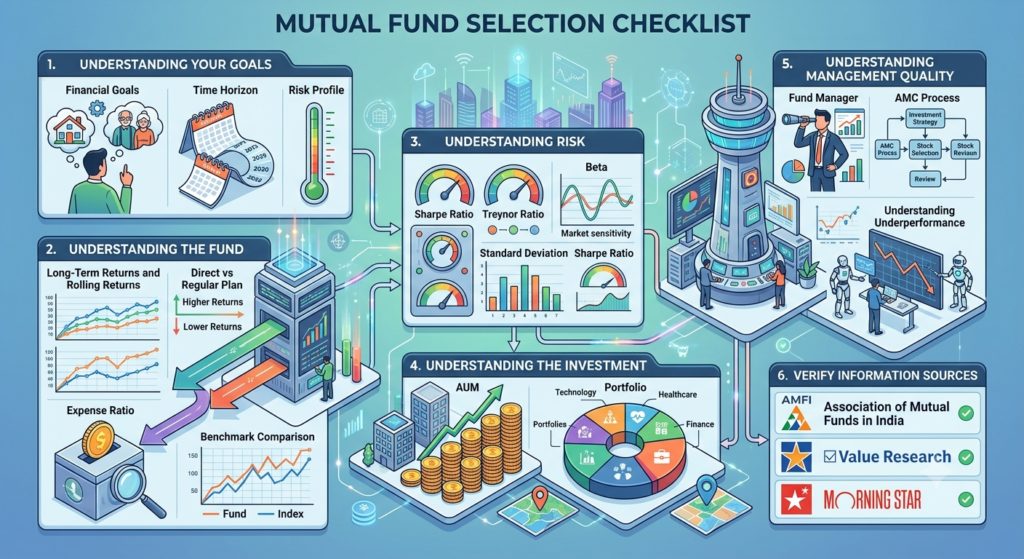
Before investing, review these key parameters:
- Investment Goal: Ensure the fund matches your financial objective and investment horizon.
- Fund Category: Choose a category that suits your risk profile, such as Large-Cap, Mid-Cap, Small-Cap, Flexi-Cap, or Index Funds.
- Long-Term Performance: Analyse consistent returns across different market cycles rather than one-year performance.
- Benchmark Comparison: Check whether the fund has created value compared with its benchmark index.
- Risk Metrics: Evaluate Sharpe Ratio, Sortino Ratio, Alpha, Beta, and Standard Deviation.
- Costs: Compare expense ratio and understand Direct vs Regular Plans.
- Portfolio Quality: Review holdings, sector allocation, diversification, and concentration risk.
- Fund Manager & AMC: Evaluate the investment process, experience, and consistency.
- Trusted Information: Verify details using official sources such as AMC factsheets and scheme documents.
📌 Remember
The objective is not to find yesterday’s best-performing fund. The objective is to select a quality fund that aligns with your financial goals and can be held through different market cycles.
Who Should Read This Guide?
This guide is designed for anyone who wants to understand how to evaluate mutual funds before investing. Whether you are a first-time investor or someone looking to improve your existing portfolio, the principles discussed here can help you make more informed decisions.
This guide is especially useful for:
- First-time mutual fund investors who want to understand the basics of fund selection before starting their investment journey.
- SIP investors who want to choose suitable mutual funds for long-term wealth creation instead of investing based only on recommendations or recent returns.
- Investors comparing multiple mutual funds who want a structured framework to analyse performance, risk, costs, and portfolio quality.
- Existing investors reviewing their portfolio who want to check whether their current funds continue to match their financial goals.
- Long-term wealth creators who understand that successful investing requires patience, discipline, and selecting quality funds rather than chasing short-term performance.
Note: Scope of This Guide
This guide primarily focuses on evaluating actively managed mutual funds, where fund managers make investment decisions with the objective of generating returns through portfolio selection and management.
Index Funds and ETFs follow a passive investment approach and require different evaluation criteria, such as tracking error, tracking difference, liquidity, and index replication quality. These topics will be covered separately in dedicated guides.
💡 Before You Begin
You do not need to become a financial expert to select mutual funds wisely. However, understanding a few important concepts—such as returns, risk, costs, portfolio allocation, and fund management—can help you make better investment decisions.
Before You Choose a Mutual Fund, Remember These Three Rules
Before comparing mutual funds, it’s important to understand three basic principles that can help you make better investment decisions.
- Past returns don’t guarantee future performance. A fund that performed exceptionally well last year may not continue delivering the same results.
- Higher returns usually come with higher risk. Always evaluate how much risk a fund takes to generate its returns.
- The best mutual fund is the one that matches your financial goals and risk tolerance—not necessarily the one with the highest returns.
What Should You Check Before Investing in a Mutual Fund?
When evaluating a mutual fund, don’t focus on just one number. A good fund is the result of several factors working together. In the following sections, we’ll examine the 12 most important parameters, starting with Financial Goals, Time Horizon & Risk Profile and moving on to historical performance, costs, risk, portfolio quality, and fund management.
1. Choose the Right Mutual Fund Based on Your Financial Goals, Time Horizon & Risk Profile
The best mutual fund isn’t the one with the highest past returns—it’s the one that aligns with your financial goals, investment time horizon, and risk profile.
These three factors work together to help you choose investments that are appropriate for your needs:
- 🎯 Financial Goal – Why are you investing?
- ⏳ Investment Horizon – When will you need the money? How long you can stay invested.
- 📊 Risk Tolerance – How much volatility can you handle? How comfortable you are with market ups and downs.
In general, the longer your investment horizon, the more risk you may be able to take, giving your investments more time to recover from short-term market fluctuations.
Which Fund Category Fits Your Goal?
| Investment Horizon: Risk Level | Typical Financial Goals | Suitable Mutual Fund Categories |
|---|---|---|
| Less than 1 year: Low | Emergency fund, temporary parking of money | Debt Funds (Overnight Funds, Liquid Funds) |
| 1–3 years: Low to Moderate | Vacations, vehicle purchase, planned expenses | Short Duration Debt Funds, Conservative Hybrid Funds |
| 3–5 years: Moderate | Home down payment, medium-term financial goals | Hybrid Funds, Medium Duration Debt Funds |
| 5+ years: Moderate to High | Wealth creation, retirement, children’s education | Equity Funds, Index Funds, Flexi Cap Funds, Large & Mid Cap Funds |
Understanding Your Risk Tolerance
Your risk tolerance is your ability and willingness to handle temporary declines in the value of your investments.
Two people with the same financial goal may choose different mutual funds because they’re comfortable with different levels of risk.
| Investor Profile | Comfortable With | May Consider |
|---|---|---|
| 🟢 Conservative | Capital preservation and lower volatility | Debt Funds, Conservative Hybrid Funds |
| 🟡 Moderate | A balance between growth and stability | Debt Funds, Hybrid Funds |
| 🔴 Aggressive | Higher short-term volatility for long-term growth | Equity Funds, Index Funds, Flexi Cap Funds, Mid Cap Funds |
💡 Quick Tip
Time horizon and risk tolerance go hand in hand.
- If you need your money soon, protecting your capital is usually more important than chasing higher returns.
- If your goal is many years away, temporary market declines are generally less impactful because your investments have more time to recover and grow.
Choosing investments that match both your financial goal and your comfort with risk can help you stay invested through changing market conditions.
📌 Remember
There is no universally “best” mutual fund category.
A fund is only suitable if it aligns with:
- 🎯 Your financial goal
- ⏳ Your investment time horizon
- 📊 Your risk tolerance
✅ Key Takeaway: The right investment is one that aligns with your financial goals, investment time horizon, and risk profile—not someone else’s portfolio.
2. Evaluate Historical Returns, But Focus on Consistency
Historical returns are often the first thing investors look at when comparing mutual funds—and for good reason. They provide a snapshot of how a fund has performed over different periods. However, choosing a mutual fund based only on last year’s returns can lead to poor investment decisions.
A fund that delivered exceptional returns during one year may simply have benefited from favorable market conditions or a temporary rally in a particular sector. What matters more is whether the fund has been able to deliver consistent performance across different market cycles.
Instead of asking, “Which fund gave the highest return?”, ask, “Which fund has consistently rewarded investors over the long term?” This simple shift in thinking can help you identify stronger and more reliable mutual funds.
Compare Returns Across Different Time Horizons
Rather than focusing on a single performance period, review how the mutual fund has performed over multiple investment horizons.
- 1-Year Returns: Show recent performance but can be heavily influenced by short-term market movements.
- 3-Year Returns: Provide a better indication of how the fund performs over a complete market phase.
- 5-Year Returns: Help evaluate the fund’s consistency across different market conditions.
- 10-Year Returns (if available): Offer valuable insights into how the fund has managed multiple bull and bear markets.
Longer performance history generally provides greater confidence in evaluating a fund’s investment strategy. While past performance does not guarantee future returns, a fund that consistently performs well over several years is often a better candidate than one with only a short period of outstanding returns.
Why Rolling Returns Are More Reliable Than Trailing Returns
Most investors compare mutual funds using trailing returns. These returns measure performance between two fixed dates—for example, the last one year or the last five years.
The problem is that trailing returns depend entirely on the chosen start and end dates. If a fund happened to begin measuring after a market crash or end during a market rally, its returns may appear much better than they actually are.
Rolling returns solve this problem. Instead of measuring performance over just one period, they calculate returns across hundreds of overlapping periods. This provides a much clearer picture of how consistently the fund has generated returns regardless of market conditions.
For long-term investors, rolling returns are one of the most reliable indicators of a fund’s quality because they reduce the impact of unusually good or bad market timing.
📊 Example
Suppose two mutual funds both generated a 15% five-year return.
- Fund A delivered steady returns throughout the five years.
- Fund B underperformed for most of the period but experienced one sharp rally during the final year.
Although both funds show the same five-year return, their rolling returns will reveal that Fund A has been much more consistent. For long-term investing, consistency is usually more valuable than occasional bursts of exceptional performance.
💡 Quick Tips
- ✓ Compare 1-year, 3-year, 5-year, and 10-year returns.
- ✓ Give more importance to 5-year and 10-year performance.
- ✓ Prefer funds with consistent rolling returns.
- ✓ Avoid selecting a fund solely because it was the top performer last year.
- ✓ Compare returns with the fund’s benchmark instead of looking at returns in isolation.
⚠️ Common Mistakes to Avoid
- ❌ Choosing a fund based only on its 1-year returns.
- ❌ Ignoring how the fund performed during market downturns.
- ❌ Comparing funds from different categories (for example, a Large-Cap Fund with a Small-Cap Fund).
- ❌ Assuming the highest-returning fund will continue to outperform in the future.
✅ Key Takeaway: Don’t chase the highest returns. Instead, look for mutual funds that have consistently delivered strong performance across different market cycles while managing risk effectively.
3. Direct Plan vs Regular Plan: Which One Should You Choose?
Finding a high-performing mutual fund is only part of the investment journey. The next question is equally important: How much of those returns will actually reach your pocket?
This is where understanding the difference between Direct Plans and Regular Plans becomes essential. Both plans invest in the same portfolio and are managed by the same fund manager. The only difference lies in how you invest—and how much you pay for that convenience.
What Is a Direct Plan?
A Direct Plan allows you to invest directly with the Asset Management Company (AMC) without involving a distributor or intermediary. Since there are no commission costs, Direct Plans have a lower expense ratio.
Because the annual expenses are lower, a larger portion of your investment remains invested and continues to compound over time. Even a small difference in costs can significantly increase your wealth over long investment periods.
What Is a Regular Plan?
A Regular Plan is purchased through a mutual fund distributor, bank, broker, or financial advisor. In return for their services, a commission is paid from the fund’s expenses, resulting in a higher expense ratio.
The higher cost doesn’t mean the investment strategy is different—the fund manager, portfolio, and underlying investments remain exactly the same. The difference is simply the additional distribution cost built into the plan.
Direct Plan vs Regular Plan
| Feature | Direct Plan | Regular Plan |
|---|---|---|
| Where you invest | Directly with the AMC | Through a distributor or advisor |
| Expense Ratio | Lower | Higher |
| Distributor Commission | Not Applicable | Included |
| Long-Term Returns | Usually Higher | Slightly Lower |
| Best For | DIY investors (Do-It-Yourself investors) | Investors who need professional guidance |
Why Choosing the Right Plan Matters
At first glance, the difference in expenses may seem insignificant. However, mutual funds are long-term investments, and annual costs are deducted every year before returns are credited to investors.
Over time, these seemingly small charges reduce the power of compounding. The lower the annual expenses, the more of your money remains invested and continues to generate returns.
That’s why many experienced investors prefer Direct Plans when they are comfortable selecting and managing their own investments.
Are Regular Plans Ever a Good Choice?
Yes. If you’re new to investing or prefer professional guidance, a qualified financial advisor can help you select suitable funds, build a diversified portfolio, and avoid costly investment mistakes.
In such cases, paying a slightly higher expense ratio through a Regular Plan may be worthwhile if the advice adds value to your overall financial decisions.
⚠️ Common Mistakes to Avoid
- ❌ Assuming Direct Plans and Regular Plans invest in different portfolios.
- ❌ Choosing a Regular Plan without understanding the additional costs involved.
- ❌ Selecting a Direct Plan if you need ongoing investment guidance but don’t have the time or confidence to manage your portfolio.
✅ Key Takeaway: Direct and Regular Plans invest in the same mutual fund. The primary difference is cost. If you’re comfortable making investment decisions on your own, a Direct Plan can help maximise long-term wealth by keeping expenses lower. If you value professional advice, a Regular Plan may still be the right choice despite its higher cost.
4. Why the Expense Ratio Matters in Mutual Funds
Even the best-performing mutual fund can become less rewarding if its costs are too high. That’s why understanding the expense ratio is essential before investing.
The expense ratio is the annual fee charged by a mutual fund to manage your investment. It covers expenses such as fund management, administrative costs, registrar fees, marketing, and other operational expenses. This fee is deducted from the fund’s assets, so you don’t pay it separately—but it directly reduces your overall returns.
While the difference may seem small, even a slightly higher expense ratio can significantly reduce your wealth over the long term because of the power of compounding.
What Is an Expense Ratio?
The expense ratio is expressed as a percentage of the fund’s average assets under management (AUM). For example, if a mutual fund has an expense ratio of 1%, it means the fund deducts ₹1 annually for every ₹100 invested to cover its operating expenses.
These charges are adjusted within the fund’s Net Asset Value (NAV), so investors don’t receive a separate bill. However, the impact is reflected in the returns you earn over time.
Why a Lower Expense Ratio Can Improve Long-Term Returns
Mutual funds are designed for long-term wealth creation. Over long investment horizons, every percentage point saved in costs remains invested and continues to compound.
For example, imagine two mutual funds generate identical gross returns over 20 years. If one fund has a lower expense ratio, investors in that fund will typically accumulate a larger investment corpus simply because less money is deducted each year.
This is why experienced investors pay close attention to expenses, especially when comparing similar mutual funds within the same category.
Is a Lower Expense Ratio Always Better?
Not necessarily.
While lower costs generally benefit investors, the expense ratio should never be evaluated in isolation. A fund with a slightly higher expense ratio may still be a better investment if it consistently delivers superior risk-adjusted returns and outperforms its benchmark over the long term.
The key is to compare expense ratios only among mutual funds in the same category. For example, compare one Large-Cap Fund with another Large-Cap Fund—not with a Small-Cap or International Fund, where operating costs may naturally differ.
💡 Pro Tip: When comparing two mutual funds with similar investment objectives, historical performance, and risk levels, the one with the lower expense ratio often has a long-term advantage because more of your money remains invested and compounds over time.
⚠️ Common Mistakes to Avoid
- ❌ Choosing a fund solely because it has the lowest expense ratio.
- ❌ Comparing expense ratios across different categories of mutual funds.
- ❌ Ignoring the impact of expenses on long-term compounding.
- ❌ Assuming a higher expense ratio always indicates better fund management.
✅ Key Takeaway: A lower expense ratio helps you retain more of your investment returns, but it should be considered alongside the fund’s performance, risk profile, and consistency. The best mutual fund is not necessarily the cheapest—it’s the one that delivers the best overall value.
5. Compare the Mutual Fund with Its Benchmark
A mutual fund’s returns become meaningful only when you compare them with an appropriate benchmark. Looking at returns in isolation doesn’t tell you whether the fund manager has genuinely added value or simply benefited from a rising market.
A benchmark acts as a performance yardstick. It allows you to measure whether a mutual fund has performed better, worse, or in line with the market segment it invests in.
For example, if an actively managed Large-Cap Fund delivers a 14% annual return, it may seem impressive. However, if its benchmark index generated 16% during the same period, the fund actually underperformed the market despite earning positive returns.
What Is a Benchmark?
A benchmark is a market index that reflects the performance of a specific group of securities. Every mutual fund is assigned a benchmark based on its investment objective, making it easier for investors to evaluate the fund’s performance.
Think of a benchmark as the “report card” against which a mutual fund is assessed. If the benchmark represents the market, the fund manager’s goal is to deliver better risk-adjusted returns than that benchmark over the long term.
Common Mutual Fund Benchmarks in India
| Fund Category | Common Benchmark |
|---|---|
| Large-Cap Funds | Nifty 50 Index |
| Large & Mid-Cap Funds | Nifty LargeMidcap 250 Index |
| Mid-Cap Funds | Nifty Midcap 150 Index |
| Small-Cap Funds | Nifty Smallcap 250 Index |
| Flexi-Cap Funds | Nifty 500 Index |
| ELSS Funds | Nifty 500 TRI (commonly used) |
Why Comparing with the Benchmark Is Important
One of the primary objectives of an actively managed mutual fund is to outperform its benchmark after accounting for expenses and risk. If a fund consistently fails to beat its benchmark over long periods, investors should question whether the higher management costs are justified.
Benchmark comparison also helps eliminate misleading conclusions. A mutual fund may post positive returns during a bull market, but if the benchmark performed significantly better, the fund manager may not have created additional value for investors.
📊 Example
Suppose you’re comparing two Large-Cap Funds over the last five years.
| Fund A | Benchmark | |
|---|---|---|
| 5-Year CAGR | 14.8% | 13.2% |
Fund A has outperformed its benchmark by 1.6 percentage points. This suggests that the fund manager has added value through stock selection and portfolio management.
Now imagine another fund that generated a 12.5% CAGR during the same period. Although the return is positive, it still lagged behind the benchmark. In that case, investors could have earned higher returns simply by tracking the index.
Should a Mutual Fund Outperform Its Benchmark Every Year?
No.
Even the best mutual funds experience periods of underperformance. Market cycles, investment style, sector allocation, and economic conditions can all influence short-term results.
Instead of focusing on a single year, evaluate whether the fund has consistently outperformed its benchmark over longer periods such as three, five, or ten years. Long-term consistency is far more meaningful than occasional short-term outperformance.
Benchmark Comparison: 10-Year Return Potentials
Different mutual fund categories carry different levels of risk and return potential, as shown in the table below.
| Category: Benchmark | 10-Year Return Potential (CAGR): Risk Level | Best For |
|---|---|---|
| Small-Cap Equity: Nifty Smallcap 250 | 15% – 20% : Very High | Aggressive long-term wealth seekers |
| Mid-Cap Equity: Nifty Midcap 150 | 14% – 18% : High | Investors seeking a balance of risk and growth |
| Large-Cap Equity: Nifty 50 | 10% – 14% : Moderate | Conservative beginners wanting stability |
| Flexi-Cap Equity: Nifty 500 | 12% – 16% : Moderate-High | Hands-off diversification across all company sizes |
Note: Higher return potential generally comes with higher risk. However, higher-risk investments do not guarantee higher returns, and all investments are subject to market risk.
💡 Pro Tip: Always compare a mutual fund with its own benchmark—not with another category of funds. For example, compare a Large-Cap Fund with the Nifty 50 Index, not with a Small-Cap Fund that naturally carries higher risk and return potential.
⚠️ Common Mistakes to Avoid
- ❌ Judging a fund solely by its absolute returns.
- ❌ Comparing funds from different categories.
- ❌ Expecting a fund to outperform its benchmark every single year.
- ❌ Ignoring benchmark performance when selecting actively managed funds.
✅ Key Takeaway: A mutual fund’s performance should always be evaluated relative to its benchmark. Consistently outperforming the benchmark over multiple market cycles is a stronger indicator of fund quality than simply delivering high returns during favorable market conditions.
6. Evaluate Risk-Adjusted Returns: Is the Fund Taking Too Much Risk?
Imagine two mutual funds that both delivered an annual return of 15%. At first glance, they appear equally good. But what if one fund achieved those returns with relatively stable performance, while the other experienced sharp ups and downs along the way?
Most investors would prefer the fund that generated similar returns with lower risk. This is the idea behind risk-adjusted returns.
Risk-adjusted performance measures how efficiently a mutual fund converts risk into returns. Instead of asking, “How much did the fund earn?”, it answers a more important question: “How much risk did the fund take to earn those returns?”
This helps investors identify funds that consistently reward investors without exposing them to excessive volatility.
Why Risk-Adjusted Returns Matter
Higher returns often come with higher risk. A mutual fund may generate exceptional returns during a strong bull market simply because it invested aggressively in volatile stocks. However, the same strategy could lead to significant losses during market downturns.
Risk-adjusted performance ratios help you determine whether a fund manager is generating returns through disciplined investment decisions or by taking unnecessary risks.
When comparing mutual funds within the same category, these ratios provide a more complete picture than returns alone.
Sharpe Ratio: How Much Return Is Generated for Every Unit of Risk?
The Sharpe Ratio is one of the most widely used measures of risk-adjusted performance. It evaluates how much additional return a mutual fund generates for each unit of total risk taken.
In simple terms, a higher Sharpe Ratio indicates that the fund has rewarded investors more efficiently for the level of risk it assumed.
When comparing similar mutual funds, a higher Sharpe Ratio generally indicates better risk-adjusted performance.
Preferred: Higher
💡 Pro Tip: Only compare Sharpe Ratios between mutual funds in the same category. Comparing a Large-Cap Fund with a Small-Cap Fund can produce misleading conclusions because their risk profiles are very different.
Sortino Ratio: Focusing Only on Downside Risk
The Sortino Ratio is similar to the Sharpe Ratio but focuses only on harmful volatility—the downside risk that investors actually worry about.
Unlike the Sharpe Ratio, it ignores positive price movements and measures how effectively the fund generates returns while minimizing losses.
A higher Sortino Ratio generally indicates better downside risk management and a smoother investment experience during market declines.
Preferred: Higher
Sharpe Ratio vs Sortino Ratio
- Sharpe Ratio considers both upward and downward price fluctuations.
- Sortino Ratio focuses only on downside volatility.
Because investors are usually more concerned about losses than gains, many analysts prefer the Sortino Ratio when evaluating equity mutual funds.
Treynor Ratio: Measuring Return Relative to Market Risk
The Treynor Ratio evaluates how much excess return a mutual fund generates for each unit of market risk, also known as systematic risk.
This ratio is particularly useful when comparing well-diversified portfolios because it focuses on the portion of risk that cannot be eliminated through diversification.
Like the Sharpe Ratio, a higher Treynor Ratio generally indicates better risk-adjusted performance.
Preferred: Higher
Jensen’s Alpha: Has the Fund Manager Added Value?
Jensen’s Alpha, often simply called Alpha, measures whether a mutual fund has generated returns above or below what would normally be expected based on the level of market risk it has taken.
A positive Alpha suggests that the fund manager has added value through effective stock selection and portfolio management. A negative Alpha indicates that the fund has underperformed relative to expectations.
When comparing actively managed mutual funds, consistently positive Alpha is generally considered a sign of skilled fund management.
Preferred: Positive and Higher
Quick Reference: Risk-Adjusted Performance Ratios
| Parameter | What It Measures | Preferred Value |
|---|---|---|
| Sharpe Ratio | Return earned for total risk taken | Higher |
| Sortino Ratio | Return earned for downside risk | Higher |
| Treynor Ratio | Return earned for market risk | Higher |
| Jensen’s Alpha | Manager’s ability to outperform expectations | Positive & Higher |
⚠️ Common Mistakes to Avoid
- ❌ Looking only at returns while ignoring the level of risk involved.
- ❌ Comparing risk ratios across different mutual fund categories.
- ❌ Assuming the highest-returning fund is automatically the best investment.
- ❌ Using a single ratio to make an investment decision instead of evaluating multiple factors together.
✅ Key Takeaway: Strong mutual funds don’t just generate higher returns—they generate those returns efficiently. Risk-adjusted performance ratios help you identify funds that reward investors without taking excessive risk, making them an essential part of mutual fund analysis.
7. Understand the Fund’s Risk Level: Beta and Standard Deviation Explained
Returns tell you how much a mutual fund has earned. Risk tells you how those returns were achieved.
Two mutual funds may deliver similar long-term returns, but one may experience much larger ups and downs than the other. For many investors, especially beginners, understanding this difference is just as important as evaluating returns.
Two commonly used metrics for measuring a mutual fund’s risk are Beta and Standard Deviation. Together, they help you understand how volatile a fund is and how it is likely to behave under different market conditions.
Beta: How Sensitive Is the Fund to Market Movements?
Beta measures how much a mutual fund tends to move compared with its benchmark or the overall market.
It helps investors understand whether the fund is likely to experience larger or smaller price swings than the market during both rising and falling phases.
- Beta = 1: The fund generally moves in line with the market.
- Beta greater than 1: The fund is expected to be more volatile than the market.
- Beta less than 1: The fund is generally less volatile than the market.
Conservative investors often prefer funds with a lower Beta, while aggressive investors may be comfortable with a higher Beta in pursuit of potentially higher returns.
📊 Example
If the market rises by 10% and a mutual fund with a Beta of 1.2 increases by around 12%, it has amplified the market’s movement.
Similarly, if the market falls by 10%, the same fund could decline by approximately 12%.
This doesn’t mean the fund is bad—it simply means it is more sensitive to market movements.
Standard Deviation: How Stable Are the Fund’s Returns?
While Beta measures how a fund moves relative to the market, Standard Deviation measures how much the fund’s own returns fluctuate over time.
A fund with a lower Standard Deviation has historically delivered more stable returns, while a higher Standard Deviation indicates greater volatility.
Lower volatility doesn’t automatically mean better performance, but it often provides a smoother investment experience and may be more suitable for investors with a lower risk tolerance.
Preferred: Lower (when comparing similar mutual funds)
Beta vs Standard Deviation
| Beta | Standard Deviation |
|---|---|
| Measures how the fund moves relative to the market. | Measures how much the fund’s own returns fluctuate over time. |
| Compares market sensitivity. | Measures overall volatility. |
| Useful for understanding market risk. | Useful for understanding return consistency. |
How Should Investors Use Beta and Standard Deviation?
Neither Beta nor Standard Deviation should be viewed in isolation. Instead, use them alongside historical performance, benchmark comparison, and risk-adjusted return ratios.
When comparing two mutual funds within the same category, lower volatility combined with consistent long-term returns often indicates a more disciplined investment strategy.
Remember that every investor’s risk tolerance is different. A higher-risk fund may be suitable for a young investor with a long investment horizon, while a lower-risk fund may be more appropriate for someone seeking greater stability.
💡 Pro Tip: Don’t reject a mutual fund simply because it has a higher Beta or Standard Deviation. Growth-oriented categories such as Mid-Cap and Small-Cap Funds naturally experience greater volatility than Large-Cap Funds. Always compare risk metrics within the same category and consider whether the potential return justifies the additional risk.
⚠️ Common Mistakes to Avoid
- ❌ Assuming a higher Beta always means a better-performing fund.
- ❌ Comparing risk metrics across different categories of mutual funds.
- ❌ Ignoring volatility when evaluating historical returns.
- ❌ Choosing a low-risk fund if it doesn’t align with your financial goals and investment horizon.
✅ Key Takeaway: Beta and Standard Deviation help you understand how much risk a mutual fund has historically taken. Use these metrics to select funds whose level of volatility matches your financial goals, investment horizon, and risk tolerance—not simply the highest returns.
Quick Recap: Mutual Fund Selection Criteria – What We’ve Covered So Far
- ✔️ Identify financial goals, investment time horizon, and risk profile.
- ✔️ Check long-term and rolling returns for consistency.
- ✔️ Choose between Direct and Regular Plans based on your needs.
- ✔️ Compare expense ratios within the same fund category.
- ✔️ Evaluate performance against the fund’s benchmark.
- ✔️ Use risk-adjusted ratios to judge return efficiency.
- ✔️ Understand Beta and Standard Deviation before investing.
Next, we’ll examine the fund itself—its size, portfolio composition, diversification, sector allocation, and the people managing your money.
8. Evaluate the Fund’s Assets Under Management (AUM)
One of the first details you’ll notice in a mutual fund factsheet is its Assets Under Management (AUM). While many investors assume that a larger AUM automatically means a better mutual fund, that’s not always true.
AUM simply tells you the total market value of all the money that investors have entrusted to the fund. Although it can provide useful insights into a fund’s popularity and scale, it should never be the sole reason for choosing or rejecting a mutual fund.
What Is Assets Under Management (AUM)?
Assets Under Management (AUM) represent the total value of investments managed by a mutual fund on behalf of its investors.
As investors buy or redeem units and as the value of the underlying investments changes, the fund’s AUM also changes over time.
For example, if a mutual fund manages investments worth ₹10,000 crore, its AUM is ₹10,000 crore.
Why Does AUM Matter?
AUM gives investors a general idea of the fund’s size, liquidity, and investor confidence. However, a very small or an extremely large AUM can sometimes create challenges depending on the type of mutual fund.
Rather than looking for the biggest fund, investors should look for a fund with an AUM that is appropriate for its investment strategy and category.
Small AUM vs Large AUM
| Smaller AUM | Larger AUM |
|---|---|
| Can be more flexible while buying and selling stocks. | Often reflects strong investor confidence and market acceptance. |
| May have lower liquidity if the fund remains very small. | Generally offers better operational stability. |
| May carry higher business risk if investor participation remains limited. | Can find it difficult to quickly invest or exit positions in less liquid stocks. |
Why AUM Should Be Evaluated by Fund Category
The ideal AUM varies across different types of mutual funds.
- Large-Cap Funds: A higher AUM is generally not a concern because these funds invest in highly liquid companies that are actively traded.
- Mid-Cap Funds: Moderate to large AUM is usually manageable, but excessively large funds may gradually lose flexibility.
- Small-Cap Funds: Very large AUM can sometimes become a disadvantage because buying and selling relatively illiquid stocks without affecting prices becomes more difficult.
- Debt and Liquid Funds: Higher AUM often reflects stronger liquidity and operational stability.
Does a Higher AUM Mean a Better Mutual Fund?
No.
A mutual fund should not be selected simply because it manages a large amount of money. While a growing AUM may indicate investor confidence, it does not guarantee superior future performance.
Many relatively smaller funds have consistently outperformed larger competitors through disciplined stock selection and efficient portfolio management.
Always evaluate AUM together with historical performance, expense ratio, benchmark comparison, portfolio quality, and fund management.
💡 Pro Tip: Don’t chase the largest mutual fund in a category. Instead, ask whether the fund’s size supports its investment strategy. For example, an extremely large Small-Cap Fund may face more challenges investing efficiently than a Large-Cap Fund of the same size.
⚠️ Common Mistakes to Avoid
- ❌ Assuming the fund with the highest AUM is automatically the best choice.
- ❌ Ignoring category-specific differences when evaluating AUM.
- ❌ Rejecting smaller funds without considering their long-term performance.
- ❌ Using AUM as the only measure of a mutual fund’s quality.
✅ Key Takeaway: AUM tells you how large a mutual fund is, but it doesn’t tell you how well it is managed. Use AUM as one piece of the puzzle, and always evaluate it alongside the fund’s performance, costs, portfolio quality, and investment strategy.
9. Analyse the Portfolio: Diversification, Holdings and Sector Allocation
A mutual fund’s past performance tells you what happened. Its portfolio tells you why it happened.
Before investing, it is important to understand where your money is actually being invested. A good mutual fund is not just about high returns—it is also about owning quality businesses through a well-constructed portfolio.
Portfolio analysis helps investors understand the fund’s investment style, concentration risk, diversification level, and whether the strategy matches their financial goals.
Check the Fund’s Top Holdings
Every mutual fund publishes its portfolio holdings, showing the companies where it has invested your money.
Reviewing the top holdings helps you understand:
- The quality of companies owned by the fund.
- Whether the fund is concentrated in a few stocks.
- Whether the investment style matches your expectations.
- Whether you already own similar companies through other investments.
Concentration vs Diversification: Finding the Right Balance
Mutual funds follow different portfolio strategies. Some funds hold a smaller number of high-conviction stocks, while others spread investments across many companies.
| Concentrated Portfolio | Diversified Portfolio |
|---|---|
| Invests heavily in fewer companies. | Spreads investments across many companies. |
| Higher potential upside if stock selections perform well. | Reduces dependence on individual companies. |
| Higher stock-specific risk. | Generally smoother performance. |
Is a Concentrated Portfolio Bad?
Not necessarily.
A concentrated portfolio can perform exceptionally well when the fund manager’s high-conviction ideas succeed. Many successful investors follow this approach.
However, concentration also increases risk because a poor performance by a few major holdings can significantly impact the entire portfolio.
The right approach depends on the investor’s risk tolerance and investment objective.
💡 Pro Tip: When analysing a mutual fund, don’t just look at the number of stocks. A fund holding 50 stocks can still be concentrated if the top five holdings represent a large portion of the portfolio. Always check the weight of the largest holdings.
Review the Fund’s Sector Allocation
A mutual fund’s returns are also influenced by the sectors where it invests. Different sectors perform differently depending on economic conditions, interest rates, consumer demand, and business cycles.
Reviewing sector allocation helps you understand whether the fund has excessive exposure to a particular industry.
Why Sector Diversification Matters
Heavy exposure to a single sector can increase risk. If that sector faces regulatory challenges, economic slowdown, or changing market conditions, the fund’s performance may suffer significantly.
For example, a fund heavily concentrated in one cyclical sector may perform extremely well during favourable conditions but experience sharper declines when the cycle reverses.
A balanced portfolio generally reduces dependence on any single industry.
Should Investors Avoid Sector Concentration Completely?
No.
Some actively managed funds intentionally take sector positions because fund managers may identify attractive opportunities in specific industries.
The important question is whether the concentration is a deliberate investment strategy and whether the potential reward justifies the additional risk.
Understand Market-Cap Allocation
Mutual funds may invest across companies of different sizes:
- Large-Cap Companies: Established businesses with relatively stable operations.
- Mid-Cap Companies: Growing companies with higher growth potential and moderate risk.
- Small-Cap Companies: Smaller businesses with higher growth potential but greater volatility.
Understanding market-cap exposure helps investors know whether the fund’s risk level matches their investment horizon and expectations.
Questions to Ask Before Investing
- ✔️ Do I understand the companies and sectors the fund invests in?
- ✔️ Is the portfolio diversified enough for my risk tolerance?
- ✔️ Are the top holdings creating excessive concentration risk?
- ✔️ Does the fund’s investment style match my financial goals?
- ✔️ Do I already own similar exposure through other mutual funds?
⚠️ Common Mistakes to Avoid
- ❌ Choosing a fund without checking its portfolio holdings.
- ❌ Assuming more stocks always means better diversification.
- ❌ Ignoring sector concentration risk.
- ❌ Investing in multiple funds that hold the same companies.
- ❌ Buying a fund without understanding its investment style.
✅ Key Takeaway: A mutual fund’s portfolio reveals the true nature of your investment. Before investing, understand what companies, sectors, and market segments the fund owns. A well-constructed portfolio should match your risk tolerance, investment goals, and overall financial plan.
10. Evaluate the Fund Manager and AMC Investment Process
A mutual fund’s performance is influenced by many factors, but the fund manager and the Asset Management Company (AMC) play an important role in shaping investment decisions.
The fund manager decides which securities to buy, sell, or hold based on the fund’s investment objective and strategy. However, investors should not evaluate a fund only by looking at the name or reputation of one individual. The quality of the overall investment process matters just as much.
A good fund manager combines experience, research capability, discipline, and a consistent investment approach to manage investors’ money across different market cycles.
What Is the Role of a Fund Manager?
A fund manager is responsible for making investment decisions on behalf of mutual fund investors.
Their responsibilities include:
- Selecting stocks or securities that fit the fund’s investment strategy.
- Deciding when to increase or reduce exposure to specific investments.
- Managing portfolio risk during different market conditions.
- Ensuring the portfolio remains aligned with the fund’s stated objective.
The fund manager’s decisions can significantly influence how a fund performs over the long term.
Check the Fund Manager’s Experience and Track Record
When analysing a mutual fund, investors should review the fund manager’s experience and previous performance history.
Important factors include:
- Years of experience managing mutual funds.
- Experience across different market cycles.
- Investment philosophy and decision-making approach.
- Performance of funds managed previously.
However, remember that past success of a fund manager does not guarantee future performance. The objective is to understand whether the manager follows a disciplined and repeatable process.
What Happens When a Fund Manager Changes?
A change in fund manager does not automatically mean a mutual fund will perform poorly. However, it is something investors should monitor because a new manager may bring a different investment style or strategy.
When a fund manager changes, consider:
- Who is the new fund manager?
- What is their investment philosophy?
- Do they have experience managing similar funds?
- Has the fund’s portfolio strategy changed after the transition?
Should You Invest Only Because of a Famous Fund Manager?
No.
While a talented fund manager can add significant value, relying entirely on one individual’s ability creates unnecessary dependency risk.
Well-managed Asset Management Companies usually have strong research teams, established investment frameworks, and clearly defined processes that continue even when individual managers change.
A sustainable investment process is often more important than a single person’s reputation.
💡 Pro Tip: When evaluating a mutual fund, don’t ask only, “Who is the fund manager?” Also ask “What investment process does the AMC follow?” A strong system can reduce dependence on any single individual.
Evaluate the AMC Behind the Fund
The Asset Management Company provides the larger framework within which fund managers operate.
Factors that indicate a strong AMC include:
- A consistent investment philosophy across funds.
- Strong research and risk management systems.
- Transparent communication with investors.
- A disciplined approach during market extremes.
A strong AMC does not guarantee returns, but it can provide a stable foundation for managing investments.
⚠️ Common Mistakes to Avoid
- ❌ Investing only because a fund manager is famous.
- ❌ Ignoring changes in fund management.
- ❌ Assuming past success of a manager guarantees future returns.
- ❌ Evaluating the manager but ignoring the AMC’s overall investment process.
✅ Key Takeaway: A good fund manager can influence performance, but a strong investment process creates long-term consistency. Evaluate the manager’s experience, the AMC’s framework, and whether the fund follows a disciplined approach rather than relying only on past success.
11. Understand Why a Mutual Fund Underperforms
Even the best-performing mutual funds will experience periods of underperformance. Markets move in cycles, investment styles go through phases, and no fund manager makes the right decision every time.
A temporary decline or a period of weaker returns does not necessarily mean that a mutual fund has become a poor investment. The important question is why the fund underperformed.
Understanding the reason behind underperformance helps investors distinguish between a temporary setback and a genuine warning sign.
Short-Term Underperformance Can Be Normal
Mutual funds may underperform their benchmark or category peers for several temporary reasons.
Common reasons include:
- Market conditions that do not favor the fund’s investment style.
- Temporary weakness in sectors where the fund has higher exposure.
- Short-term volatility in specific stocks held by the fund.
- A market environment where certain categories are outperforming others.
For long-term investors, short-term underperformance should be analysed rather than immediately treated as a reason to exit.
A. Broad Market Decline
Sometimes a fund underperforms simply because the entire market is going through a correction.
During periods of economic uncertainty, interest rate changes, geopolitical events, or global market weakness, most equity funds may experience declines.
If the fund falls broadly in line with its benchmark and continues following its stated investment strategy, the decline may not indicate a serious problem.
B. Temporary Weakness in the Fund’s Investment Style
Different investment styles perform better during different market phases.
For example:
- Growth-oriented funds may perform strongly during periods when investors prefer high-growth companies.
- Value-oriented funds may outperform when undervalued companies regain investor interest.
A fund may temporarily lag simply because the market is favoring a different investment style—not because the fund manager has lost the ability to select investments.
C. Sector-Specific Weakness
If a mutual fund has significant exposure to a particular sector, weakness in that industry can affect short-term performance.
For example, banking, technology, energy, or healthcare sectors may experience periods of strong performance followed by temporary declines.
The key question is whether the sector allocation was part of a well-researched strategy or an unintended concentration risk.
D. Poor Stock Selection or Strategy Issues
Not all underperformance is temporary. Sometimes a fund struggles because of genuine investment problems.
Warning signs may include:
- Consistent underperformance over multiple market cycles.
- Repeated poor stock selection decisions.
- Major deviation from the fund’s stated investment objective.
- Frequent changes in strategy without clear explanation.
- Loss of confidence in the fund management process.
How Long Should Investors Wait Before Taking Action?
There is no fixed time period that applies to every mutual fund. The evaluation depends on the fund category, investment strategy, and reason for underperformance.
Instead of reacting to a few months of weak returns, investors should review:
- Performance over multiple years.
- Rolling returns compared with the benchmark.
- Changes in portfolio strategy.
- Fund manager continuity.
- Whether the original investment thesis still remains valid.
💡 Pro Tip: Do not replace a mutual fund simply because another fund is currently performing better. Market leaders keep changing. A disciplined fund that temporarily underperforms can recover, while today’s top performer may not remain at the top forever.
When Is Underperformance a Genuine Concern?
Investors should consider reviewing their investment when underperformance is accompanied by fundamental changes such as:
- Persistent poor performance compared with the benchmark and peers.
- A significant change in investment strategy.
- A major change in fund management without a smooth transition.
- Increasing concentration or risk-taking that does not match the fund objective.
- Concerns about the AMC’s overall investment practices.
⚠️ Common Mistakes to Avoid
- ❌ Selling a fund after a short period of poor performance.
- ❌ Chasing whichever fund delivered the highest recent returns.
- ❌ Ignoring the reason behind underperformance.
- ❌ Comparing funds without considering their investment style and category.
✅ Key Takeaway: Underperformance is not always a reason to exit a mutual fund. The right approach is to understand the cause, evaluate whether the investment process remains intact, and make decisions based on long-term fundamentals rather than short-term emotions.
12. Verify Mutual Fund Information Using Trusted Sources
Before investing in a mutual fund, investors should always verify important information from reliable and official sources.
Mutual fund decisions should be based on facts such as portfolio holdings, expense ratio, benchmark performance, risk metrics, and scheme objectives—not only on recommendations or recent returns.
Using trustworthy sources helps investors avoid misleading information and make more informed investment decisions.
Why Should Investors Verify Mutual Fund Data?
Mutual fund information changes regularly. Portfolio holdings, fund size, expense ratios, fund managers, and performance numbers can change over time.
Checking updated information ensures that your investment decision is based on the current position of the fund rather than outdated data.
Reliable sources also provide standardized information, making it easier to compare different mutual funds objectively.
1. Association of Mutual Funds in India (AMFI)
The Association of Mutual Funds in India (AMFI) ↗ is the industry association representing mutual funds in India.
It provides important investor resources and official mutual fund-related information, including scheme details, industry data, and investor education material.
Investors can use AMFI as a reliable reference point when verifying mutual fund information.
2. Asset Management Company (AMC) Website and Factsheets
Every mutual fund house publishes monthly factsheets containing important details about its schemes.
A mutual fund factsheet typically includes:
- Fund objective and investment strategy.
- Portfolio holdings.
- Sector allocation.
- Fund manager details.
- Expense ratio.
- Risk measures.
- Performance history.
Reading the factsheet helps investors understand what they actually own before investing.
3. Scheme Information Document (SID)
The Scheme Information Document (SID) contains detailed information about a mutual fund scheme’s structure, objectives, investment approach, risks, and terms.
Before investing, investors should review the SID to understand:
- The fund’s investment objective.
- Where the scheme can invest.
- Associated risks.
- Investment restrictions.
- Fund-related charges and conditions.
Although the SID may appear detailed, it provides the most comprehensive official information about the scheme.
4. Independent Mutual Fund Research Platforms
Independent research platforms (like Value Research ↗, Morningstar ↗) can help investors compare mutual funds using additional analytical tools and simplified ratings.
They may provide information such as:
- Historical returns.
- Risk ratios.
- Fund comparisons.
- Portfolio analysis.
- Performance rankings.
However, investors should use these platforms as research aids rather than blindly following ratings or rankings.
Do Not Depend Only on Ratings or Rankings
Mutual fund ratings can be useful for filtering options, but they should not replace proper analysis.
A five-star rating does not guarantee future returns, and a lower-rated fund is not automatically a poor investment.
Investors should consider ratings along with:
- Long-term consistency.
- Investment strategy.
- Risk level.
- Portfolio quality.
- Fund management process.
💡 Pro Tip: Before investing in any mutual fund, spend a few minutes checking three things from official sources: the latest factsheet, current portfolio holdings, and expense ratio. These three details can reveal a lot about the quality and suitability of a fund.
Quick Mutual Fund Verification Checklist
| Information to Check | Where to Verify |
|---|---|
| Fund objective | AMC website / SID |
| Portfolio holdings | AMC factsheet |
| Expense ratio | AMC website / factsheet |
| Benchmark | Scheme documents |
| Risk statistics | Factsheet / research platforms |
| Fund manager details | AMC website |
⚠️ Common Mistakes to Avoid
- ❌ Selecting a fund only because of online rankings.
- ❌ Investing based only on recent returns.
- ❌ Ignoring official scheme documents.
- ❌ Using outdated information while making investment decisions.
✅ Key Takeaway: Successful mutual fund investing requires reliable information. Use official sources such as AMC documents, factsheets, and AMFI resources along with independent research tools to make decisions based on facts rather than emotions or marketing claims.
Step-by-Step Process to Select a Mutual Fund for Long-Term Investment
Selecting a mutual fund should be a structured process rather than an emotional decision based on recent returns or market trends.
A disciplined investor evaluates the fund’s suitability, performance, risk, cost, portfolio quality, and management process before investing.
The following step-by-step framework combines all the important parameters discussed in this guide and helps investors make a more informed decision.
Step 1: Define Your Investment Goal and Time Horizon
Before selecting a mutual fund, first understand why you are investing.
Your investment goal determines the type of fund that may be suitable for you.
| Investment Goal | Possible Suitable Categories |
|---|---|
| Long-term wealth creation | Equity mutual funds |
| Short-term capital protection | Debt or liquid funds |
| Retirement planning | Long-term diversified equity funds |
| Child education planning | Goal-based long-term investment options |
A fund that is excellent for one investor may not be suitable for another because financial goals and risk tolerance differ.
Step 2: Choose the Right Mutual Fund Category
Before comparing individual funds, select the appropriate category based on your risk profile and investment horizon.
Different categories carry different levels of volatility and return potential.
- Large-Cap Funds: Generally more stable with moderate growth potential.
- Mid-Cap Funds: Higher growth potential with increased volatility.
- Small-Cap Funds: Higher long-term growth potential but greater fluctuations.
- Flexi-Cap Funds: Flexible allocation across company sizes.
- Index Funds: Designed to replicate market indices at lower costs.
Choosing the right category is often more important than choosing the individual fund.
Step 3: Create a Shortlist of Funds
Once you identify the suitable category, shortlist a few funds for comparison.
Avoid selecting a fund simply because it:
- Has the highest one-year return.
- Has recently become popular.
- Appears frequently in advertisements.
Instead, focus on funds with:
- Consistent long-term performance.
- Reasonable costs.
- Strong portfolio quality.
- A stable investment approach.
Step 4: Compare Long-Term Performance and Benchmark Returns
Evaluate the shortlisted funds across multiple periods:
- 3-year returns
- 5-year returns
- 10-year returns (where available)
- Rolling returns across different market cycles
Then compare performance against the fund’s benchmark and category peers.
A good mutual fund should demonstrate consistency rather than depend on one exceptional year.
Step 5: Evaluate Risk-Adjusted Performance
Do not judge a fund only by returns. Analyse whether those returns were achieved efficiently.
Review metrics such as:
- Sharpe Ratio
- Sortino Ratio
- Treynor Ratio
- Jensen’s Alpha
- Beta
- Standard Deviation
The objective is to find funds that deliver competitive returns without taking unnecessary risk.
Step 6: Analyse Portfolio Quality
Study what the fund actually owns.
Review:
- Top holdings.
- Sector allocation.
- Market-cap exposure.
- Portfolio concentration.
- Investment style.
A portfolio should match your expectations regarding risk and diversification.
Step 7: Review Fund Manager and AMC Quality
Evaluate the people and process behind the fund.
Check:
- Fund manager experience.
- Stability of the investment team.
- AMC’s investment philosophy.
- Consistency of the decision-making process.
A strong process can be more valuable than depending on one individual’s past success.
Step 8: Check Costs and Choose the Appropriate Plan
Costs directly affect long-term wealth creation because every percentage point saved compounds over time.
Review:
- Expense ratio.
- Direct vs Regular Plan.
- Exit load and other applicable charges.
For investors who can independently research and manage investments, Direct Plans are generally preferred because they have lower costs.
Step 9: Invest Gradually and Review Periodically
Investing is not a one-time activity. Even after selecting a mutual fund, investors should review it periodically.
Monitoring does not mean reacting to every market movement. Instead, review whether:
- The fund continues to follow its stated strategy.
- The investment objective remains unchanged.
- The fund manager and process remain stable.
- Performance remains reasonable over long periods.
💡 Pro Tip: The goal is not to find the fund with the highest return today. The goal is to select a high-quality fund that has a strong probability of delivering sustainable long-term results while matching your risk profile.
Mutual Fund Selection Framework: Quick Checklist
| Parameter | What to Look For |
|---|---|
| Goal | Matches your investment objective |
| Category | Suitable for your risk level |
| Returns | Consistent long-term performance |
| Benchmark | Competitive performance versus index |
| Risk Ratios | Efficient return generation |
| Portfolio | Quality and diversification |
| Fund Manager | Strong process and stability |
| Cost | Reasonable expense ratio |
✅ Key Takeaway: Choosing a mutual fund is a process of elimination, not prediction. By evaluating goals, category, performance, risk, portfolio quality, costs, and management quality together, investors can make more informed long-term investment decisions.
Common Mistakes Beginners Make While Selecting Mutual Funds
Choosing a mutual fund is not only about finding good numbers. It is also about avoiding common mistakes that can negatively impact long-term investment outcomes.
Many investors make decisions based on recent performance, emotions, or incomplete information. Understanding these mistakes can help investors build a more disciplined approach.
1. Selecting a Mutual Fund Based Only on Recent Returns
One of the most common mistakes beginners make is choosing a fund because it delivered the highest returns recently.
A fund that performed exceptionally well in the last one or two years may have benefited from favourable market conditions, a particular sector cycle, or temporary trends.
However, past winners do not always remain future winners.
Instead of focusing only on recent returns, evaluate:
- Long-term performance consistency.
- Rolling returns across market cycles.
- Benchmark performance.
- Risk-adjusted returns.
💡 Pro Tip: Do not ask, “Which fund gave the highest return last year?” Ask, “Which fund has demonstrated a consistent investment process across different market conditions?”
2. Blindly Following Star Ratings and Rankings
Mutual fund ratings can be useful for shortlisting funds, but they should not become the only basis for investment decisions.
Ratings are based on historical data and may change over time. A highly rated fund today may not necessarily deliver similar results in the future.
Investors should use ratings as a starting point and combine them with:
- Portfolio analysis
- Fund strategy
- Expense ratio
- Risk measures
- Investment philosophy
3. Ignoring Expense Ratio and Plan Type
Many investors focus entirely on returns and overlook costs. However, expenses directly reduce the amount of money that compounds over time.
A small difference in annual expenses can create a meaningful difference in wealth creation over long investment periods.
Investors should understand:
- Direct Plan vs Regular Plan
- Expense ratio differences
- Impact of costs on long-term returns
4. Holding Too Many Mutual Funds
Many investors believe that owning more mutual funds automatically creates better diversification. However, having too many similar funds can create unnecessary complexity.
Multiple funds may actually own many of the same companies, resulting in hidden concentration.
A well-selected portfolio of a few suitable funds is often more effective than holding numerous overlapping schemes.
5. Choosing a Fund Without Understanding Its Category
Different mutual fund categories have different risk and return characteristics.
A Small-Cap Fund and a Large-Cap Fund cannot be evaluated using the same expectations.
Before investing, understand:
- Where the fund invests.
- How much volatility it may experience.
- Whether it matches your investment horizon.
6. Selling During Temporary Market Corrections
Market declines are a normal part of equity investing. However, many investors exit quality funds during temporary downturns because of fear.
Selling during corrections can convert temporary declines into permanent losses and may prevent investors from benefiting from future recovery.
The better approach is to review whether the fund’s fundamentals have changed.
7. Frequently Changing Mutual Funds
Constantly switching from one fund to another based on short-term performance can negatively affect long-term wealth creation.
Every change should have a valid reason, such as:
- Fund strategy has changed.
- Consistent long-term underperformance.
- Major change in investment philosophy.
Changing funds simply because another fund is temporarily performing better often leads to chasing returns.
8. Selecting Funds That Do Not Match Your Risk Profile
The best-performing mutual fund is not necessarily the best fund for every investor.
A fund should match:
- Your financial goals.
- Your investment timeline.
- Your ability to tolerate market fluctuations.
- Your overall portfolio allocation.
A suitable fund that you can hold through market cycles is often better than a high-return fund that causes you to panic during volatility.
Quick Summary: Mistakes to Avoid
| Mistake | Better Approach |
|---|---|
| Choosing highest recent returns | Focus on long-term consistency |
| Following ratings blindly | Analyse multiple parameters |
| Ignoring costs | Compare expense ratios |
| Owning too many funds or frequently changing funds | Maintain a focused and well diversified portfolio |
| Choosing inappropriate fund category | Evaluate risk and return characteristics differently |
| Selling during corrections | Review fundamentals first |
| Chasing market trends | Follow a disciplined strategy |
✅ Key Takeaway: Successful mutual fund investing is not only about selecting good funds—it is also about avoiding poor decisions. A disciplined investor focuses on long-term quality, controls emotions, understands risk, and avoids chasing short-term performance.
Mutual Fund Selection Checklist: 15 Things to Check Before Investing
Selecting a mutual fund requires more than looking at past returns. A good investment decision involves evaluating performance, risk, cost, portfolio quality, and suitability for your financial goals.
Use this checklist before investing in any mutual fund to ensure you have evaluated the important factors.
☐ 1. Does the Fund Match Your Investment Goal?
- ☐ Have you clearly defined your financial goal?
- ☐ Is your investment horizon suitable for this fund category?
- ☐ Can you remain invested through market fluctuations?
A fund should be selected based on your financial objective, not simply because it has delivered high returns.
☐ 2. Have You Chosen the Right Mutual Fund Category?
- ☐ Do you understand whether the fund is Large-Cap, Mid-Cap, Small-Cap, Flexi-Cap, Index, Debt, or Hybrid?
- ☐ Does the risk level match your comfort level?
- ☐ Does the category suit your investment duration?
☐ 3. Has the Fund Delivered Consistent Long-Term Performance?
- ☐ Reviewed 3-year returns?
- ☐ Reviewed 5-year returns?
- ☐ Checked 10-year performance (if available)?
- ☐ Evaluated rolling returns instead of only point-to-point returns?
Consistency across different market cycles is generally more meaningful than one exceptional year.
☐ 4. Has the Fund Outperformed Its Benchmark?
- ☐ Identified the fund’s official benchmark?
- ☐ Compared long-term performance against the benchmark?
- ☐ Checked whether outperformance is consistent?
☐ 5. Have You Evaluated Costs?
- ☐ Checked the expense ratio?
- ☐ Compared Direct Plan vs Regular Plan?
- ☐ Understood how costs affect long-term compounding?
Lower costs can significantly improve long-term wealth creation.
☐ 6. Has the Fund Generated Returns Efficiently?
- ☐ Checked Sharpe Ratio?
- ☐ Checked Sortino Ratio?
- ☐ Reviewed Jensen’s Alpha?
- ☐ Compared risk-adjusted performance with similar funds?
☐ 7. Do You Understand the Fund’s Risk Level?
- ☐ Checked Beta?
- ☐ Reviewed Standard Deviation?
- ☐ Understood how the fund behaves during market declines?
☐ 8. Have You Reviewed What the Fund Owns?
- ☐ Checked top holdings?
- ☐ Reviewed quality of companies in the portfolio?
- ☐ Understood the investment style?
☐ 9. Is the Portfolio Properly Diversified?
- ☐ Checked concentration in top holdings?
- ☐ Reviewed sector allocation?
- ☐ Avoided excessive overlap with your existing investments?
☐ 10. Is the Fund’s AUM Appropriate?
- ☐ Checked Assets Under Management?
- ☐ Compared AUM with similar funds?
- ☐ Considered whether the fund size suits its category?
A large AUM does not automatically mean a better fund.
☐ 11. Have You Evaluated the Fund Manager and AMC?
- ☐ Checked fund manager experience?
- ☐ Reviewed investment philosophy?
- ☐ Considered AMC’s overall process?
- ☐ Monitored recent manager changes?
☐ 12. Have You Investigated Periods of Poor Performance?
- ☐ Understood why the fund underperformed?
- ☐ Differentiated between temporary weakness and structural problems?
- ☐ Checked whether the original investment strategy remains intact?
☐ 13. Have You Verified Information From Reliable Sources?
- ☐ Checked AMC factsheet?
- ☐ Reviewed Scheme Information Document (SID)?
- ☐ Verified details through official sources?
☐ 14. Does This Fund Add Something New to Your Portfolio?
- ☐ Checked overlap with existing mutual funds?
- ☐ Avoided buying multiple funds with similar holdings?
- ☐ Ensured proper diversification?
☐ 15. Do You Have a Long-Term Review Strategy?
- ☐ Will you review periodically rather than daily?
- ☐ Will you avoid reacting emotionally to market movements?
- ☐ Will you make changes only when fundamentals change?
Mutual Fund Selection Parameters Overview
| Parameter | What to Check |
|---|---|
| Goal | Matches your financial objective |
| Category | Suitable risk and investment horizon |
| Returns | Long-term consistency |
| Benchmark | Competitive performance |
| Costs | Low expense ratio and suitable plan |
| Risk | Sharpe, Sortino, Beta, Standard Deviation |
| Portfolio | Quality, diversification, concentration |
| AUM | Appropriate fund size |
| Management | Strong process and stability |
| Sources | Verified official information |
Quick Mutual Fund Selection Checklist
| Parameter | Preferred Value / Target Direction | Purpose |
|---|---|---|
| Step 1: Understanding Your Goals | ||
| Financial Goals, Time Horizon & Risk Profile | Different for each person | These three factors work together to help you choose appropriate fund |
| Step 2: Understanding the Fund | ||
| Long-Term Returns and Rolling Returns | Higher and Consistent ⬆️ | How the mutual fund has performed |
| Direct vs Regular Plan | Direct Plan | How much you pay for expenses |
| Expense Ratio | Lower ⬇️ | Maximises compounding by lowering costs |
| Benchmark Comparison | Should Outperform Consistently | Acts as a performance yardstick |
| Step 3: Understanding Risk | ||
| Sharpe Ratio | Higher ⬆️ | Return earned for total risk taken |
| Sortino Ratio | Higher ⬆️ | Return earned for downside risk |
| Treynor Ratio | Higher ⬆️ | Return earned for market risk |
| Jensen’s Alpha | Positive and Higher ⬆️ | Confirms outperformance against the benchmark. |
| Beta | Lower (Relative) ⬇️ | Controls sensitivity to market swings |
| Standard Deviation | Lower ⬇️ | Minimises portfolio volatility |
| Step 4: Understanding the Investment | ||
| AUM | Healthy and Sustainable | Gives a general idea of the fund’s size, liquidity, and investor confidence |
| Portfolio | Well diversified but should match your risk tolerance, investment goals, and overall financial plan | Understand what companies, sectors, and market segments the fund owns |
| Step 5: Understanding Management Quality | ||
| Fund Manager | Stable Track Record | Making investment decisions on behalf of You |
| AMC Process | Long-term framework | Making larger framework within which fund managers operate |
| Underperformance | Decide based on long-term fundamentals rather than short-term performance. | Understanding the reason behind underperformance |
| Step 6: Making an Informed Decision | ||
| Information Sources | AMFI, Value Research, Morning Star | Screen potential funds |
✅ Key Takeaway: A good mutual fund selection process is not about finding yesterday’s top performer. It is about identifying a fund with a suitable strategy, consistent performance, reasonable risk, efficient costs, and a strong investment process that matches your long-term goals.
🎯 Conclusion: Selecting the Right Mutual Fund Requires a Disciplined Approach
Choosing a mutual fund is not about finding the fund that delivered the highest returns in the past or selecting the most popular scheme in the market.
A successful investment decision requires a deeper understanding of performance, risk, cost, portfolio quality, and the investment process behind the fund.
Before investing, investors should evaluate:
- Long-term and rolling return consistency.
- Performance compared with the appropriate benchmark.
- Risk-adjusted return measures.
- Expense ratio and plan structure.
- Portfolio diversification and quality.
- Fund manager experience and AMC investment process.
- Whether the fund continues to match their financial goals.
The most important lesson is that mutual fund selection is not about predicting tomorrow’s top performer. It is about identifying a suitable investment option with a strong process, reasonable costs, and the ability to remain invested through different market conditions.
Markets will always experience periods of growth, decline, uncertainty, and recovery. A disciplined investor focuses on quality, patience, and consistency rather than reacting to short-term noise.
Final Reminder
Do not ask only, “Which mutual fund gave the highest return?”
Ask:
- Does this fund match my financial goals?
- Do I understand the risks involved?
- Is the investment process consistent?
- Can I stay invested through market cycles?
The right mutual fund is not necessarily the one that performed best yesterday. It is the one that is suitable for your journey toward your financial goals.
Final Words
Mutual fund investing rewards discipline more than excitement. By following a structured evaluation process and avoiding common mistakes, investors can make more informed decisions and build a portfolio designed for long-term wealth creation.
📌 Remember
Good investing is not about chasing returns—it is about making thoughtful decisions and staying committed to your financial plan.
📖 Next Read: Screen Mutual Fund Schemes with Official AMFI Performance Data
Now that you understand the key parameters for evaluating a mutual fund scheme, it’s time to screen potential funds and choose your first scheme with confidence. Verify historical performance directly on AMFI using official, unbiased data, compare returns across categories and benchmarks, and shortlist schemes based on transparent performance metrics before making your investment decision.
❓ Frequently Asked Questions (FAQs): How to Choose Mutual Funds
Choosing the right mutual fund can feel confusing, especially for beginners. The following frequently asked questions address common doubts investors have before making an investment decision.
1. How Should a Beginner Choose a Mutual Fund?
Beginners should start by identifying their financial goal, investment horizon, and risk tolerance. After selecting the appropriate fund category, evaluate factors such as long-term performance, benchmark comparison, expense ratio, portfolio quality, risk metrics, and fund management process.
The best mutual fund is not necessarily the one with the highest recent return, but the one that matches your financial needs and has a consistent long-term approach.
2. Should I Select a Mutual Fund Based Only on Past Returns?
No. Past returns are useful but should not be the only selection criteria.
Investors should also evaluate how consistently the fund performed, whether it outperformed its benchmark, the risk taken to generate returns, portfolio quality, costs, and the fund manager’s investment approach.
3. How Many Mutual Funds Should I Have in My Portfolio?
There is no fixed number that works for every investor. The right number depends on your investment goals, portfolio size, and diversification needs.
Owning too many mutual funds can create unnecessary complexity and may result in overlapping investments. A focused portfolio of suitable funds is often easier to monitor and manage.
4. Is Direct Plan Better Than Regular Plan?
Direct Plans generally have lower expense ratios because they do not include distributor commissions. Over long investment periods, the lower cost can improve wealth accumulation through compounding.
However, investors should choose a plan based on their ability to research, select, and manage investments. Investors who need professional guidance may prefer working with an advisor through a Regular Plan.
5. Should I Invest in a Five-Star Rated Mutual Fund?
Not necessarily. Ratings are based on historical performance and may change over time.
A rating can help shortlist funds, but investors should also analyse the fund’s objective, benchmark performance, portfolio quality, risk measures, costs, and consistency.
6. What Is More Important: Higher Returns or Lower Risk?
Both matter. The ideal investment generates strong returns while taking an appropriate level of risk.
Risk-adjusted measures such as Sharpe Ratio and Sortino Ratio help investors understand whether a fund generated returns efficiently rather than simply taking excessive risk.
7. How Often Should I Review My Mutual Funds?
Investors should review mutual funds periodically rather than monitoring them daily.
A review may focus on:
– Changes in fund strategy
– Fund manager changes
– Long-term performance consistency
– Portfolio changes
– Whether the fund still matches your goals
Frequent switching based on short-term market movements is generally not helpful for long-term investors.
8. Should I Exit a Mutual Fund If It Is Underperforming?
Not always. First understand why the fund is underperforming.
Temporary weakness due to market cycles or sector performance may be normal. However, consistent underperformance combined with changes in strategy, management issues, or poor portfolio decisions may require a review.
9. Are Mutual Funds With Higher AUM Better?
No. A higher AUM indicates that the fund manages more investor money, but it does not guarantee better returns.
AUM should be evaluated along with the fund category, investment strategy, portfolio quality, performance consistency, and management process.
10. Should Beginners Choose Index Funds or Active Mutual Funds?
Both approaches have advantages.
Index funds aim to replicate a market index and generally have lower costs. Actively managed funds attempt to outperform their benchmarks through research and fund manager decisions.
The suitable choice depends on an investor’s preference, understanding, risk tolerance, and investment objectives.
11. Is a High-Volatility Mutual Fund Always a Bad Choice?
No. Higher volatility is often associated with categories such as Mid-Cap and Small-Cap Funds, which may offer higher long-term growth potential.
The important factor is whether the volatility matches your investment horizon and ability to tolerate fluctuations.
📚 Glossary: Mutual Fund Selection Parameters
Before analysing mutual funds, it is helpful to understand a few basic terms that You frequently encounter while comparing different schemes.
- AMFI (Association of Mutual Funds in India)
The industry body that regulates and publishes official information about mutual funds in India, including scheme performance and industry data. - Mutual Fund Performance
A measure of how a mutual fund has performed over different time periods, such as 1-year, 3-year, 5-year, and since inception. - Direct Plan
A mutual fund investment option without distributor commissions, typically offering lower expense ratios and potentially higher long-term returns. - Benchmark Index
A market index used to compare a mutual fund’s performance and evaluate whether the fund has outperformed or underperformed its benchmark. - Scheme Category
The broad classification of a mutual fund, such as Equity, Debt, Hybrid, Solution-Oriented, or Other Schemes. - Scheme Sub-Category
A more specific classification within a mutual fund category, such as Large Cap Fund, Small Cap Fund, Mid Cap Fund, or Corporate Bond Fund. - Rolling Returns
A performance metric that measures returns over multiple overlapping periods, providing a more consistent view than point-to-point returns. - Expense Ratio
The annual fee charged by a mutual fund to manage investors’ money, expressed as a percentage of the fund’s assets. - Since Inception Return
The annualized return generated by a mutual fund from its launch date until the present, showing its long-term performance history. - Risk-Adjusted Return
A performance measure that evaluates a mutual fund’s returns relative to the level of risk taken, helping investors compare funds more effectively.
✅ Final Takeaway
Selecting a mutual fund is a process of understanding, comparing, and evaluating—not guessing. A disciplined approach helps investors avoid common mistakes and build portfolios aligned with their long-term financial goals.
🚀 What to Read Next
⬅️ Types of Mutual Funds in India: A Beginner’s Guide to Choosing the Right Fund
🌱 New to Mutual Funds? Start Your Mutual Fund Investing Journey Now
📚 Explore Mutual Funds Articles & Guides
🏛️ Learn Investing, Build Wealth, and Achieve Financial Freedom
- Quick Summary: How to Select Mutual Funds
- Who Should Read This Guide?
- Before You Choose a Mutual Fund, Remember These Three Rules
- What Should You Check Before Investing in a Mutual Fund?
- 1. Choose the Right Mutual Fund Based on Your Financial Goals, Time Horizon & Risk Profile
- 2. Evaluate Historical Returns, But Focus on Consistency
- 3. Direct Plan vs Regular Plan: Which One Should You Choose?
- 4. Why the Expense Ratio Matters in Mutual Funds
- 5. Compare the Mutual Fund with Its Benchmark
- 6. Evaluate Risk-Adjusted Returns: Is the Fund Taking Too Much Risk?
- 7. Understand the Fund’s Risk Level: Beta and Standard Deviation Explained
- Quick Recap: Mutual Fund Selection Criteria – What We’ve Covered So Far
- 8. Evaluate the Fund’s Assets Under Management (AUM)
- 9. Analyse the Portfolio: Diversification, Holdings and Sector Allocation
- 10. Evaluate the Fund Manager and AMC Investment Process
- 11. Understand Why a Mutual Fund Underperforms
- 12. Verify Mutual Fund Information Using Trusted Sources
- Step-by-Step Process to Select a Mutual Fund for Long-Term Investment
- Common Mistakes Beginners Make While Selecting Mutual Funds
- Mutual Fund Selection Checklist: 15 Things to Check Before Investing
- 🎯 Conclusion: Selecting the Right Mutual Fund Requires a Disciplined Approach
- 📖 Next Read: Screen Mutual Fund Schemes with Official AMFI Performance Data
- ❓ Frequently Asked Questions (FAQs): How to Choose Mutual Funds
- 📚 Glossary: Mutual Fund Selection Parameters
- ✅ Final Takeaway
- 🚀 What to Read Next
 Disclaimer
The information provided on this website is purely for educational and informational purposes only and should not be construed as financial, investment, tax, or legal advice. Investments in securities markets are subject to market risks. Please read all related documents carefully before investing. Past performance is not indicative of future results. Users are advised to consult their financial advisor before making any investment decisions.