Types of Mutual Funds in India: A Beginner’s Guide to Choosing the Right Fund

If you’re new to investing, you’ve probably come across terms like Equity Funds, Debt Funds, Hybrid Funds, Index Funds, ETFs, and ELSS—and wondered whether they’re all different or simply different names for the same thing.
The truth is, not all mutual funds are designed for the same purpose.
Some aim to build long-term wealth by investing in stocks, while others focus on preserving capital, generating relatively stable income, saving taxes, or providing exposure to international markets. Choosing the right mutual fund isn’t about finding the “best” one—it’s about selecting the category that matches your financial goals, investment horizon, and comfort with risk.
The good news is that you don’t need to understand every mutual fund available in India before you start investing. Once you understand the major types of mutual funds and what each one is designed to do, the investment landscape becomes much easier to navigate.
Whether you’re investing for retirement, your child’s education, buying a home, creating an emergency fund, or simply growing your wealth over time, there’s a mutual fund category that can help you work towards that goal.
In this beginner-friendly guide, you’ll learn:
- The major types of mutual funds in India
- How each type of mutual fund works
- The potential benefits and risks of each category
- Who each type is best suited for
- How to choose the right mutual fund based on your financial goals
By the end of this guide, you’ll have a clear understanding of the different mutual fund categories and the confidence to identify which ones may be suitable for your investment journey.
- Understanding the Different Types of Mutual Funds in India
- Major Types of Mutual Funds for Beginners in India (Quick Overview)
- 1. Equity Mutual Funds: Best for Long-Term Wealth Creation
- 2. Debt Mutual Funds: Best for Stability and Capital Preservation
- 3. Hybrid Mutual Funds: Balancing Growth and Stability
- 4. ELSS Mutual Funds: Tax Saving with Long-Term Wealth Creation
- 5. Index Funds: Simple, Low-Cost Passive Investing
- 6. Exchange Traded Funds (ETFs): Market-Linked Investing with Trading Flexibility
- 7. Solution-Oriented Mutual Funds: Investing for Specific Life Goals
- 8. Fund of Funds (FoFs): Diversification Through a Single Investment
- 9. International Mutual Funds: Diversifying Beyond Indian Markets
- How to Choose the Right Mutual Fund Category?
- 🎯 Conclusion: Understanding Mutual Fund Categories is the First Step Towards Better Investing
- 📖 Next Read: How to Choose Mutual Funds: Essential Selection Parameters
- ❓ Frequently Asked Questions (FAQs) About Types of Mutual Funds in India
- 📚 Glossary: Mutual Fund Categories in India
- 💭 Final Thoughts: Choose the Fund That Fits Your Journey
- 🚀 What to Read Next
Understanding the Different Types of Mutual Funds in India
Mutual funds can be classified in several ways—based on the assets they invest in, how they’re managed, their investment strategy, or even the financial goals they are designed to meet.
For beginners, however, it’s not necessary to learn every classification at once.
This guide focuses on the major types of mutual funds in India that every investor should understand before investing. These broad categories cover most investment needs, from long-term wealth creation and capital preservation to tax saving, passive investing, retirement planning, and global diversification.
If you’re looking for SEBI’s official mutual fund categories ↗ —such as Large Cap Funds, Mid Cap Funds, Small Cap Funds, Liquid Funds, Corporate Bond Funds, or Gilt Funds—we’ll cover those separately.
With that distinction in mind, let’s start by looking at the major mutual fund categories at a glance.
Major Types of Mutual Funds for Beginners in India (Quick Overview)
Now that you understand why different mutual fund categories exist, let’s take a quick look at these nine major types of mutual funds available in India.
Think of this table as a roadmap. It gives you a high-level overview before we explore each category in detail.
| Mutual Fund Type & Risk Level* | Primarily Invests In | Best Suited For |
|---|---|---|
| 📈 Equity Funds – High | Shares of listed companies | Long-term wealth creation |
| 💰 Debt Funds – Low to Moderate | Government securities, corporate bonds, treasury bills, and other fixed-income instruments | Capital preservation and short- to medium-term goals |
| ⚖️ Hybrid Funds – Moderate | A mix of equity and debt | Investors seeking a balance between growth and stability |
| 🧾 ELSS Funds – High | Equity with tax-saving benefits | Tax saving under Section 80C along with long-term investing |
| 📊 Index Funds – Moderate to High | Market indices such as Nifty 50 or Sensex | Low-cost passive investing |
| 🔄 Exchange Traded Funds (ETFs) – Varies | Indices, gold, bonds, or other underlying assets | Investors who prefer exchange-traded investments |
| 🎯 Solution-Oriented Funds – Moderate to High | Equity, debt, or a combination of both | Retirement planning or children’s future goals |
| 🧺 Fund of Funds (FoFs) – Depends on underlying funds | Other mutual fund schemes | Diversification through a single investment |
| 🌍 International Funds – High | Overseas stocks or international mutual funds | Global diversification |
*Important: The risk level shown above is only a broad indication. The actual risk of a mutual fund depends on what it invests in and its investment strategy. For example, two debt funds or two equity funds can have very different risk profiles.
💡 Did You Know?
While there are many mutual fund categories, Equity Funds, Debt Funds, and Hybrid Funds form the foundation of most investment portfolios. The remaining categories are generally specialised options designed to meet specific objectives, such as tax saving (ELSS), passive investing (Index Funds and ETFs), retirement planning, or international diversification.
Understanding Mutual Fund Risk
One of the biggest misconceptions among new investors is that a mutual fund’s name determines how risky it is.
In reality, the risk of a mutual fund depends primarily on the assets it invests in.
For example:
- Equity Funds generally carry higher risk because stock prices can fluctuate significantly in the short term.
- Debt Funds are typically less volatile because they invest in fixed-income securities, although they are still exposed to risks such as interest rate changes and credit risk.
- Hybrid Funds fall somewhere in between, with their risk level depending on the proportion of equity and debt in the portfolio.
This is why two mutual funds with different names can sometimes have similar levels of risk, while two funds within the same category may behave very differently.
Which Mutual Fund Category Should Beginners Start With?
If you’re investing in mutual funds for the first time, you don’t need to understand every category immediately.
A good starting point is to become familiar with these three core categories:
- Equity Funds: Ideal for long-term wealth creation and investors who are comfortable with market fluctuations.
- Debt Funds: Suitable for preserving capital, managing short-term goals, and reducing overall portfolio volatility.
- Hybrid Funds: A balanced option for investors who want exposure to equity while also benefiting from the relative stability of debt investments.
Once you’re comfortable with these broad categories, you can explore specialised mutual funds such as ELSS, Index Funds, ETFs, Fund of Funds, Solution-Oriented Funds, and International Funds based on your specific financial goals.
✅ Key Takeaway
There is no single “best” type of mutual fund. Each category serves a different purpose. The right choice depends on your financial goals, investment horizon, and risk tolerance—not on which category has delivered the highest returns in the past.
In the following sections, we’ll explore each type of mutual fund in detail, including how it works, its advantages and risks, who it is best suited for, and when you should consider investing in it.
1. Equity Mutual Funds: Best for Long-Term Wealth Creation
If your goal is to build wealth over the long term—whether for retirement, your child’s education, buying a home, or achieving financial independence—Equity Mutual Funds are often among the first investment options to consider.
These funds have the potential to deliver higher long-term returns than many traditional investment options. However, that growth potential comes with market fluctuations, which means your investment value can rise or fall in the short term.
That’s why equity funds are generally best suited for investors who have a long investment horizon and are comfortable with taking some market risk in pursuit of potentially higher returns.
What Are Equity Mutual Funds?
Equity Mutual Funds are mutual fund schemes that invest primarily in the shares of publicly listed companies.
When you invest in an equity fund, your money is pooled with investments from other investors. A professional fund manager then uses this pooled money to build a diversified portfolio of stocks based on the fund’s investment objective and strategy.
These companies may belong to different sectors such as banking, information technology, healthcare, manufacturing, or consumer goods. By investing across multiple companies, equity funds help reduce the risk of relying on the performance of a single stock.
Since stock prices change every day, the value of an equity mutual fund also fluctuates with market movements.
How Do Equity Mutual Funds Work?
Imagine you want to invest in the stock market but don’t have the time or expertise to research dozens of companies.
Instead of buying individual stocks yourself, you invest in an equity mutual fund. The fund manager researches companies, selects suitable investments, and manages the portfolio on your behalf.
As the prices of the underlying shares increase or decrease, the fund’s Net Asset Value (NAV) changes accordingly. If the companies in the portfolio perform well over time, the value of your investment may grow. However, if markets decline, your investment value may also fall.
In return for managing the fund, the Asset Management Company (AMC) charges a small fee, known as the expense ratio, which is reflected in the fund’s NAV.
Why Do Investors Choose Equity Mutual Funds?
The primary reason investors choose equity mutual funds is their potential to create wealth over the long term.
Historically, equities have outperformed many traditional asset classes over long investment periods, although past performance does not guarantee future returns.
Equity funds are commonly used for goals that are several years away because they give investments enough time to recover from short-term market fluctuations and benefit from the power of compounding.
Some common goals include:
- Retirement planning
- Children’s higher education
- Buying a home
- Building long-term wealth
- Financial independence
Who Should Consider Equity Mutual Funds?
Equity funds may be suitable if you:
- Are investing for goals that are at least 5 years away
- Want the potential for long-term capital appreciation
- Are comfortable with short-term market volatility
- Want your investments to potentially outpace inflation over the long run
- Prefer professional management instead of selecting individual stocks
What Are the Risks?
While equity mutual funds offer significant growth potential, they also come with risks that every investor should understand.
Market Risk
Since these funds invest in stocks, their value can rise or fall depending on market conditions, economic events, and company performance.
Short-Term Volatility
It’s normal for equity funds to experience sharp price movements over short periods. Temporary declines are a part of equity investing and should be expected.
No Guaranteed Returns
Unlike some fixed-income investments, equity mutual funds do not guarantee returns or protect your invested capital. Your returns depend on how the underlying investments perform.
For this reason, equity funds are generally better suited to long-term investors who can stay invested through different market cycles.
Quick Snapshot
| Feature | Details |
|---|---|
| Primary Investment | Shares of publicly listed companies |
| Primary Objective | Long-term capital appreciation |
| Risk Level | High |
| Ideal Investment Horizon | 5 years or more |
| Best Suited For | Investors seeking long-term wealth creation |
| Return Potential | High over the long term (not guaranteed) |
Moving to the Next Category
Equity funds can be an excellent choice for long-term wealth creation, but they aren’t the right fit for every financial goal.
If your priority is preserving capital, earning relatively stable returns, or investing for short- to medium-term goals, Debt Mutual Funds may be a more suitable option. In the next section, we’ll explore how debt funds work, their potential benefits, and the risks you should be aware of.
2. Debt Mutual Funds: Best for Stability and Capital Preservation
Not every financial goal requires taking stock market risk.
If you’re investing for a short- to medium-term goal, building an emergency fund, or simply looking for relatively stable returns, Debt Mutual Funds can be worth considering.
Unlike equity funds, which invest in company shares, debt funds invest in fixed-income securities such as government securities, corporate bonds, treasury bills, commercial papers, and other money market instruments.
Their primary objective is to provide relatively stable returns while helping preserve capital. Although debt funds are generally less volatile than equity funds, they are not risk-free, and their returns are not guaranteed.
What Are Debt Mutual Funds?
Debt Mutual Funds are mutual fund schemes that invest primarily in fixed-income securities issued by governments, companies, banks, and other financial institutions.
When you invest in a debt fund, you’re indirectly lending money to these entities. In return, they pay interest on the borrowed money, which contributes to the fund’s returns.
Depending on the type of securities they hold, debt funds may focus on short-term investments, long-term bonds, government securities, or corporate debt. This means different debt funds can have different levels of risk and return potential.
How Do Debt Mutual Funds Work?
When investors put money into a debt mutual fund, the fund manager invests that money in a portfolio of fixed-income instruments based on the fund’s investment objective.
The fund earns returns primarily through:
- Interest income received from the underlying securities.
- Changes in bond prices, which are influenced by factors such as interest rates and market conditions.
As these securities generate income or change in value, the fund’s Net Asset Value (NAV) also changes.
Although debt funds generally experience smaller price fluctuations than equity funds, their returns can still vary depending on market conditions.
Why Do Investors Choose Debt Mutual Funds?
Investors typically choose debt mutual funds when capital preservation and stability are more important than aggressive growth.
Debt funds are commonly used for:
- Short- to medium-term financial goals
- Building or managing an emergency fund
- Parking surplus money temporarily
- Reducing the overall risk of an investment portfolio
- Diversifying alongside equity investments
While debt funds may not offer the same growth potential as equity funds, they can play an important role in creating a balanced investment portfolio.
Who Should Consider Debt Mutual Funds?
Debt funds may be suitable if you:
- Have short- to medium-term financial goals
- Prefer relatively stable returns over potentially higher growth
- Want to reduce the volatility of an equity-heavy portfolio
- Are looking for an alternative to keeping surplus money idle
- Have a relatively lower risk appetite
What Are the Risks?
Although debt funds are generally considered less risky than equity funds, they are not completely risk-free.
Interest Rate Risk
Changes in interest rates can affect the value of the bonds held by the fund. When interest rates rise, the prices of existing bonds generally fall, and vice versa.
Credit Risk
If the issuer of a bond faces financial difficulties or fails to repay its obligations, the value of that security may decline, affecting the fund’s performance.
Liquidity Risk
In certain market conditions, it may become difficult to sell some debt securities quickly without affecting their price.
The level of these risks varies significantly from one debt fund to another, depending on the types of securities the fund invests in.
Quick Snapshot
| Feature | Details |
|---|---|
| Primary Investment | Government securities, corporate bonds, treasury bills, and other fixed-income instruments |
| Primary Objective | Capital preservation and relatively stable returns |
| Risk Level | Low to Moderate (varies by fund) |
| Ideal Investment Horizon | A few days to several years, depending on the fund category |
| Best Suited For | Short- to medium-term goals and conservative investors |
| Return Potential | Moderate (not guaranteed) |
Moving to the Next Category
So far, we’ve looked at two ends of the investment spectrum—Equity Funds, which focus on long-term growth, and Debt Funds, which prioritize stability.
But what if you want both growth potential and some degree of stability in a single investment?
That’s where Hybrid Mutual Funds come in. In the next section, we’ll see how these funds combine equity and debt to offer a more balanced investment approach.
3. Hybrid Mutual Funds: Balancing Growth and Stability
Many investors face a common question when they start investing:
“Should I invest in equity for higher returns or choose debt for greater stability?”
The answer doesn’t always have to be one or the other.
Hybrid Mutual Funds combine equity and debt investments in a single portfolio, aiming to strike a balance between growth and stability. By investing in both asset classes, these funds seek to offer the wealth creation potential of equities while reducing some of the volatility associated with investing only in stocks.
For investors who don’t want to decide how much to allocate between equity and debt—or regularly rebalance their portfolio—hybrid funds offer a convenient, professionally managed solution.
What Are Hybrid Mutual Funds?
Hybrid Mutual Funds are mutual fund schemes that invest in a combination of equity and debt instruments.
The exact mix of these investments varies from one fund to another. Some hybrid funds invest a larger portion in equities to focus on growth, while others allocate more to debt to emphasize stability.
This combination allows investors to gain exposure to multiple asset classes through a single investment.
How Do Hybrid Mutual Funds Work?
When you invest in a hybrid mutual fund, your money is pooled with that of other investors. The fund manager then allocates the money between equity and debt based on the fund’s investment objective.
For example:
- A fund with a higher equity allocation may offer greater growth potential but also experience more market fluctuations.
- A fund with a higher debt allocation may provide relatively stable returns with lower volatility.
The fund manager periodically reviews and rebalances the portfolio to maintain the intended asset allocation.
Why Do Investors Choose Hybrid Mutual Funds?
Hybrid funds are popular because they offer the benefits of diversification and professional asset allocation in a single investment.
Investors often choose them to:
- Balance growth and stability
- Reduce the impact of stock market volatility
- Avoid managing separate equity and debt investments
- Build a diversified portfolio with a single fund
- Invest for medium- to long-term financial goals
For many beginners, hybrid funds can be a simpler way to start investing without deciding how much to invest in each asset class.
Who Should Consider Hybrid Mutual Funds?
Hybrid funds may be suitable if you:
- Want exposure to equity but are uncomfortable investing only in stocks
- Prefer a balanced approach to investing
- Are investing for medium- to long-term financial goals
- Want professional management of your asset allocation
- Have a moderate risk appetite
What Are the Risks?
Although hybrid funds aim to balance risk and return, they are not risk-free.
Market Risk
Since hybrid funds invest in equities, their value can still fluctuate with stock market movements.
Interest Rate Risk
The debt portion of the portfolio may be affected by changes in interest rates and bond prices.
Returns Depend on Asset Allocation
The performance of a hybrid fund depends on how its investments are divided between equity and debt. Funds with higher equity exposure are generally more volatile, while those with higher debt exposure tend to be relatively stable.
Quick Snapshot
| Feature | Details |
|---|---|
| Primary Investment | A mix of equity and debt instruments |
| Primary Objective | Balance growth with stability |
| Risk Level | Moderate (varies by fund) |
| Ideal Investment Horizon | 3–5 years or longer (depending on the fund) |
| Best Suited For | Investors seeking a balance between risk and return |
| Return Potential | Moderate to High (not guaranteed) |
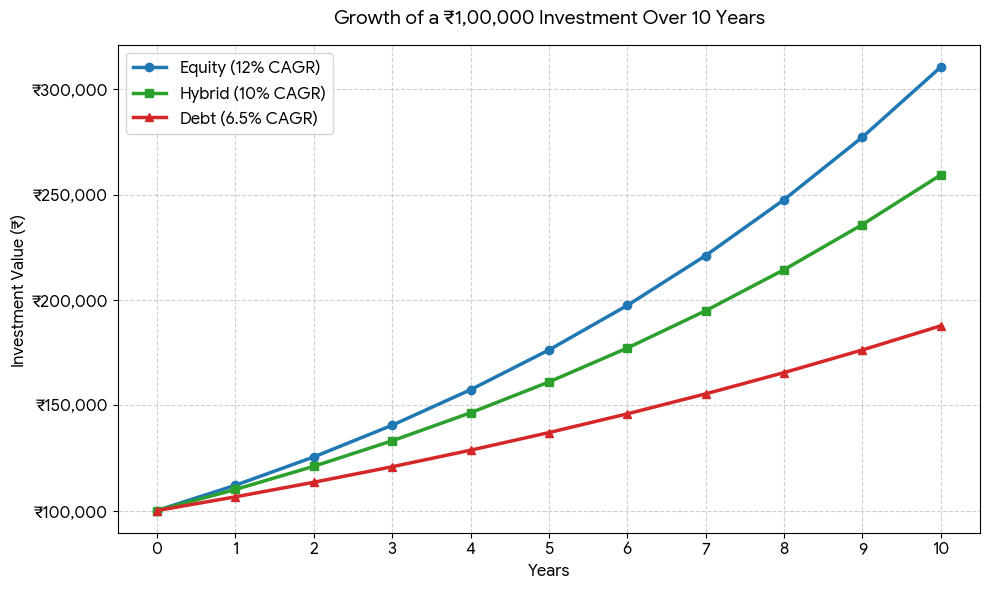
Potential Growth of Different Types of Mutual Funds
The chart below demonstrates the potential growth of a ₹1,00,000 investment over a 10-year period across Equity, Debt, and Hybrid Mutual Funds, based on assumed historical average returns. It is important to note that these figures are for illustration purposes only and do not represent guaranteed returns. Mutual fund investments are subject to market risks, and actual performance may vary depending on market conditions, fund selection, and investment duration.
Moving to the Next Category
So far, we’ve explored the three core categories of mutual funds—Equity Funds, Debt Funds, and Hybrid Funds. Together, they form the foundation of most investment portfolios.
Next, we’ll look at a more specialised category: ELSS (Equity Linked Savings Scheme). These funds not only invest in equities for long-term wealth creation but also offer tax benefits under Section 80C of the Income-tax Act, making them a popular choice for investors looking to combine tax savings with long-term investing.
4. ELSS Mutual Funds: Tax Saving with Long-Term Wealth Creation
If you’re looking to save tax while investing for long-term wealth creation, ELSS (Equity Linked Savings Scheme) is a mutual fund category worth considering.
Unlike many tax-saving investments that primarily focus on capital protection or fixed returns, ELSS funds invest mainly in equities. This means they offer the potential for long-term capital appreciation while also providing tax benefits under Section 80C of the Income-tax Act, 1961, subject to the prevailing tax rules.
One important feature of ELSS funds is their mandatory lock-in period of three years. Once you invest, you cannot redeem your units before the lock-in period ends.
What Are ELSS Mutual Funds?
ELSS (Equity Linked Savings Scheme) is a type of equity mutual fund that qualifies for tax deductions under Section 80C of the Income-tax Act, subject to the applicable tax regime and prevailing tax laws.
Like other equity funds, ELSS schemes invest predominantly in the shares of listed companies. However, what makes them different is the combination of equity investing and tax-saving benefits.
Since these funds invest in equities, they carry similar market risks as other equity mutual funds and are best suited for long-term investors.
How Do ELSS Mutual Funds Work?
When you invest in an ELSS fund, your money is pooled with that of other investors and invested primarily in a diversified portfolio of equity shares.
The fund manager selects and manages these investments with the objective of generating long-term capital appreciation.
In return for choosing an ELSS scheme, investors may be eligible to claim a tax deduction under Section 80C, subject to the applicable tax rules.
However, every investment in an ELSS fund remains locked in for three years from the date of investment.
Why Do Investors Choose ELSS Mutual Funds?
ELSS funds are popular because they combine two important benefits (save tax while investing for long-term wealth creation) in a single investment.
Investors choose them to:
- Save tax under Section 80C (subject to applicable tax rules)
- Build long-term wealth through equity investing
- Start investing with relatively small amounts through SIPs or lump-sum investments
- Develop disciplined investing through the mandatory lock-in period
For many first-time investors, ELSS serves as an introduction to equity investing while also helping with tax planning.
Who Should Consider ELSS Mutual Funds?
ELSS funds may be suitable if you:
- Want to save tax under Section 80C (subject to eligibility)
- Are comfortable investing in equities
- Have an investment horizon of at least three years (preferably longer)
- Are investing for long-term financial goals
- Can remain invested during market fluctuations
What Are the Risks?
Although ELSS funds offer tax benefits, they are equity mutual funds first. This means they carry the same market-related risks as other equity funds.
Market Risk
Since ELSS funds invest primarily in stocks, their value can fluctuate with market movements.
Lock-in Period
Your investment cannot be redeemed before completing the mandatory three-year lock-in period. Therefore, ELSS may not be suitable if you expect to need the money sooner.
No Guaranteed Returns
Like other equity mutual funds, ELSS funds do not guarantee returns or capital protection.
Quick Snapshot
| Feature | Details |
|---|---|
| Primary Investment | Shares of publicly listed companies |
| Primary Objective | Tax saving and long-term wealth creation |
| Risk Level | High |
| Ideal Investment Horizon | 3 years or longer (preferably 5+ years) |
| Best Suited For | Investors looking to combine tax saving with equity investing |
| Special Feature | Eligible for tax benefits under Section 80C (subject to applicable tax laws) and comes with a mandatory 3-year lock-in |
Moving to the Next Category
So far, we’ve explored actively managed mutual funds, where a fund manager decides which securities to buy and sell.
But what if you don’t want a fund manager trying to beat the market? What if you’re happy simply matching the performance of a market index at a lower cost?
That’s where Index Funds come in. In the next section, we’ll explore how these passive funds work and why they’ve become increasingly popular among long-term investors.
5. Index Funds: Simple, Low-Cost Passive Investing
Not every investor wants to pick the “best” mutual fund or rely on a fund manager to outperform the market.
Some investors prefer a simpler approach—earning returns that closely match the overall market while keeping investment costs low.
That’s exactly what Index Funds are designed to do.
Instead of trying to beat the market, index funds aim to replicate the performance of a specific market index, such as the Nifty 50 or the Sensex. Because they require minimal active management, they generally have lower expense ratios than actively managed mutual funds.
For investors looking for a straightforward, long-term investment strategy, index funds can be an attractive option.
What Are Index Funds?
Index Funds are passively managed mutual funds that aim to mirror the performance of a particular market index.
Rather than selecting stocks based on a fund manager’s research or market outlook, an index fund simply invests in the same companies that make up the chosen index, usually in the same proportion.
For example, a Nifty 50 Index Fund invests in the companies that are part of the Nifty 50 Index, while a Sensex Index Fund follows the companies included in the Sensex.
The objective isn’t to outperform the market—it’s to deliver returns that are as close as possible to the chosen index, after accounting for expenses and tracking differences.
How Do Index Funds Work?
An index fund tracks a predefined market index.
Suppose the Nifty 50 Index consists of 50 large companies. A Nifty 50 Index Fund invests in those same companies in approximately the same weight as the index.
As companies enter or exit the index, the fund updates its portfolio accordingly to continue tracking the index.
If the index rises, the fund’s value is also expected to rise. Likewise, if the index falls, the fund’s value is likely to decline.
Since there is no active stock selection, index funds generally have lower operating costs than actively managed funds.
Why Do Investors Choose Index Funds?
Investors often choose index funds because they offer a simple, transparent, and cost-effective way to invest in the stock market.
Some of the key reasons include:
- Low investment costs due to passive management
- Broad diversification through a single investment
- No dependence on a fund manager’s stock-picking decisions
- Easy to understand and track
- Suitable for long-term wealth creation
For many beginners, index funds provide an uncomplicated way to participate in the growth of the broader market.
Who Should Consider Index Funds?
Index funds may be suitable if you:
- Prefer a simple, long-term investment approach
- Want broad exposure to the stock market
- Are comfortable earning market-linked returns rather than trying to beat the market
- Want lower investment costs
- Believe in passive investing
What Are the Risks?
Although index funds are passively managed, they are not risk-free.
Market Risk
Since index funds track the market, they rise and fall with the underlying index. During market downturns, the value of your investment may also decline.
No Outperformance
An index fund is designed to match the market—not outperform it. If the index delivers modest returns, the fund is likely to do the same.
Tracking Difference
In practice, an index fund may not perfectly replicate the performance of its benchmark because of expenses, cash holdings, and operational factors. This difference is known as the tracking difference.
Quick Snapshot
| Feature | Details |
|---|---|
| Primary Investment | Stocks that make up a market index |
| Primary Objective | Match the performance of a chosen market index |
| Risk Level | Moderate to High (depends on the underlying index) |
| Ideal Investment Horizon | 5 years or longer |
| Best Suited For | Long-term investors who prefer passive investing |
| Special Feature | Generally lower expense ratios than actively managed equity funds |
Index Funds vs Actively Managed Funds
Many beginners wonder whether they should choose an Index Fund or an actively managed equity fund.
The key difference lies in how the portfolio is managed.
| Feature | Index Funds | Actively Managed Equity Funds |
|---|---|---|
| Investment Strategy | Tracks a market index | Aims to outperform the market |
| Role of Fund Manager | Limited | Actively selects and manages stocks |
| Expense Ratio | Generally lower | Usually higher |
| Goal | Match index returns | Beat index returns |
| Stock Selection | Based on the index | Based on the fund manager’s research |
Neither approach is inherently better. The right choice depends on your investment philosophy, financial goals, and personal preferences.
Moving to the Next Category
At first glance, Index Funds and Exchange Traded Funds (ETFs) may seem very similar because both often track a market index.
However, there’s one important difference.
While Index Funds are bought and redeemed through the mutual fund company at the day’s closing NAV, ETFs are traded on stock exchanges throughout the trading day, much like shares.
In the next section, we’ll understand how ETFs work and how they differ from Index Funds.
6. Exchange Traded Funds (ETFs): Market-Linked Investing with Trading Flexibility
Imagine you want to invest in a basket of companies, gold, or bonds—but you also want the flexibility to buy and sell your investment during market hours, just like a stock.
That’s where Exchange Traded Funds (ETFs) come in.
ETFs combine features of both mutual funds and stocks. Like mutual funds, they hold a collection of underlying assets. Like stocks, their units are bought and sold on a stock exchange throughout the trading day.
Because many ETFs follow an index or a specific asset, they are commonly used by investors looking for low-cost, transparent, and flexible investment options.
What Are Exchange Traded Funds (ETFs)?
An Exchange Traded Fund (ETF) is an investment fund that holds a basket of securities and whose units are traded on a stock exchange.
Similar to index funds, many ETFs aim to track the performance of a particular index, such as the Nifty 50 or Sensex. However, ETFs can also invest in other assets such as:
- Gold
- Bonds
- International markets
- Specific sectors or themes
The value of an ETF depends on the performance of the underlying assets it holds.
How Do ETFs Work?
When you invest in an ETF, you purchase units of the fund through a stock exchange using a trading account.
Unlike traditional mutual funds, where transactions usually happen at the end-of-day NAV, ETF prices change continuously during market hours based on demand, supply, and the value of the underlying assets.
For example:
A Nifty 50 ETF holds shares of companies that make up the Nifty 50 Index. If the value of these companies increases, the ETF price generally moves upward as well. If the index falls, the ETF value may decline.
Since ETFs are usually passively managed, many of them have lower expense ratios compared to actively managed funds.
Why Do Investors Choose ETFs?
Investors choose ETFs for several reasons:
Flexibility
ETFs can be bought and sold during market hours, giving investors more control over the timing and price of transactions.
Diversification
A single ETF can provide exposure to multiple companies, sectors, or asset classes through one investment.
Transparency
Most ETFs disclose their holdings regularly, allowing investors to understand what assets they own.
Lower Costs
Many ETFs follow passive investment strategies, which generally results in lower management costs.
Who Should Consider ETFs?
ETFs may be suitable if you:
- Have a Demat and trading account
- Understand basic stock market transactions
- Prefer the flexibility of buying and selling during market hours
- Want passive exposure to a specific index, asset, or market
- Are comfortable managing your own investment decisions
What Are the Risks?
Although ETFs offer flexibility and diversification, they also come with certain risks.
Market Risk
The value of an ETF depends on the performance of its underlying assets. If those assets decline, the ETF value may also fall.
Trading Risk
Unlike regular mutual funds, ETFs trade on exchanges. The price you pay may differ slightly from the actual value of the underlying assets due to market demand and supply.
Requires a Demat Account
Unlike most mutual funds, ETFs require a Demat and trading account, which may make them less convenient for investors who prefer a simpler investment process.
Quick Snapshot
| Feature | Details |
|---|---|
| Primary Investment | Stocks, bonds, gold, indices, or other underlying assets |
| Primary Objective | Provide exposure to a specific market or asset |
| Risk Level | Depends on the underlying asset |
| Ideal Investment Horizon | Depends on the ETF type |
| Best Suited For | Investors comfortable with exchange-traded investments |
| Special Feature | Bought and sold on stock exchanges during market hours |
Index Funds vs ETFs: Understanding the Difference
Since Index Funds and ETFs often follow the same underlying index, beginners commonly confuse the two.
The main difference is how you invest in them.
| Feature | Index Funds | ETFs |
|---|---|---|
| Buying Method | Through mutual fund platforms or AMC portals | Through stock exchanges |
| Trading Price | Based on end-of-day NAV | Changes throughout market hours |
| Demat Account | Usually not required | Required |
| Investment Style | Simpler for long-term investors | More flexible for active investors |
| Costs | Generally low | Generally low |
Neither option is automatically better. The right choice depends on your investing style, convenience, and level of involvement.
Moving to the Next Category
So far, we have explored mutual funds based on how they invest—from actively managed equity funds to passive options like Index Funds and ETFs.
But investing is not only about choosing an investment product. It is also about choosing the right approach for important financial goals.
Some goals, such as retirement planning or saving for a child’s future, require a long-term investment strategy and disciplined approach. This is where Solution-Oriented Mutual Funds come into the picture.
In the next section, we’ll understand how these funds are designed around specific life goals and why goal-based investing can help investors stay focused for the long term.
7. Solution-Oriented Mutual Funds: Investing for Specific Life Goals
Some financial goals are too important to leave to short-term decisions.
Planning for retirement or building a fund for your child’s future requires discipline, patience, and a long-term investment approach. This is where goal-based investing becomes important.
Solution-Oriented Mutual Funds are designed around specific life objectives rather than just focusing on a particular asset class.
Instead of asking: “Which fund should I invest in?”
these funds encourage investors to think:
“What financial goal am I investing for?”
The idea is simple—align your investment with an important life goal and stay invested for the required time period.
What Are Solution-Oriented Mutual Funds?
Solution-Oriented Mutual Funds are schemes designed to help investors work towards specific long-term financial goals, such as:
- Retirement planning
- Children’s future expenses
- Other long-term life objectives
These funds typically combine investments across asset classes such as equity and debt depending on their investment strategy and objective.
The key difference is that these funds are built around a specific purpose, rather than simply investing based on a particular market segment or asset class.
How Do Solution-Oriented Funds Work?
When you invest in a solution-oriented fund, your money is managed according to the fund’s stated goal.
For example:
- A retirement-focused fund aims to help investors build a corpus for their post-retirement years.
- A child-focused fund aims to help parents save for future expenses related to their child’s education or other needs.
The investment approach may change depending on the fund’s strategy and time horizon. Since these goals are usually many years away, such funds often combine growth-oriented investments with relatively stable assets.
The biggest advantage of this approach is that it encourages investors to remain focused on their goal instead of making frequent decisions based on short-term market movements.
Why Do Investors Choose Solution-Oriented Funds?
Many investors understand the importance of saving but struggle with maintaining discipline over long periods.
Solution-oriented funds are chosen because they:
- Connect investments with specific financial goals
- Encourage long-term investing discipline
- Help investors avoid unnecessary short-term decisions
- Provide a structured approach to retirement or future planning
For example, investing regularly for retirement is often easier when the investment has a clear purpose rather than being just another general savings plan.
Who Should Consider Solution-Oriented Funds?
These funds may be suitable if you:
- Are investing for a clearly defined long-term goal
- Want a structured approach to retirement planning
- Are saving for your child’s future needs
- Prefer goal-based investing over selecting funds independently
- Want to maintain investment discipline over many years
What Are the Risks?
Solution-oriented funds are not risk-free investments. Their risks depend on the underlying assets they invest in.
Market Risk
If the fund invests in equities, its value may fluctuate with stock market movements.
Long Lock-In Period
These funds are designed for long-term goals, and some may have restrictions on withdrawals. This can reduce flexibility if your financial situation changes.
Goal Mismatch Risk
Even a goal-based fund cannot guarantee that your financial target will be achieved. The final outcome depends on factors such as investment amount, time period, and market performance.
Quick Snapshot
| Feature | Details |
|---|---|
| Primary Investment | Equity, debt, or a combination of both |
| Primary Objective | Investing towards specific long-term financial goals |
| Risk Level | Moderate to High (depends on investment strategy) |
| Ideal Investment Horizon | Long term |
| Best Suited For | Investors planning retirement or major future goals |
| Special Feature | Designed around a specific financial objective rather than only an asset class |
A Note About SEBI Classification
Historically, mutual fund regulations included a separate Solution-Oriented Scheme category covering retirement and children’s funds.
However, mutual fund classifications and regulatory frameworks can evolve over time. Since this guide focuses on understanding the major types of mutual funds and their purpose, we are focusing on the concept of goal-based investing rather than detailed regulatory classification.
For a detailed explanation of SEBI’s mutual fund classification framework, refer to our dedicated guide.
Moving to the Next Category
Most mutual funds invest directly in stocks, bonds, or other securities. But some funds take a different approach—they invest in other mutual funds instead of directly buying individual assets.
These are known as Fund of Funds (FoFs). In the next section, we’ll understand how FoFs work, their advantages, and what investors should consider before investing in them.
8. Fund of Funds (FoFs): Diversification Through a Single Investment
Imagine you want to invest in multiple mutual funds but don’t want to research, select, and manage each one separately.
A Fund of Funds (FoF) offers a way to do this by investing in a portfolio of other mutual fund schemes instead of directly investing in stocks, bonds, or other securities.
In simple terms:
A mutual fund invests in assets.
A Fund of Funds invests in mutual funds.
This structure allows investors to access multiple funds or investment strategies through a single investment.
What Is Fund of Funds (FoFs)?
A Fund of Funds (FoF) is a mutual fund scheme that invests primarily in units of other mutual funds or investment funds.
Instead of directly buying shares of companies or bonds, the FoF manager selects and invests in other funds based on the scheme’s objective.
For example, a FoF may invest across:
- Equity mutual funds
- Debt mutual funds
- International funds
- Other specialised investment funds
The exact portfolio depends on the objective and strategy of the FoF.
How Do Fund of Funds Work?
When you invest in a Fund of Funds, your money is pooled with that of other investors. The FoF manager then allocates this money across selected underlying funds.
For example:
Instead of separately investing in:
- An equity fund for growth
- A debt fund for stability
- An international fund for global exposure
an investor may choose a FoF that provides exposure to multiple underlying funds through a single investment.
The performance of the FoF depends on how the underlying funds perform.
Why Do Investors Choose Fund of Funds?
Investors may choose FoFs because they offer:
Diversification
A single FoF can provide exposure to multiple funds, asset classes, or investment strategies.
Simplicity
Investors do not need to select and manage several different funds individually.
Professional Allocation
The FoF manager decides how much money should be allocated across different underlying funds based on the scheme’s objective.
Access to Certain Investment Opportunities
Some FoFs provide access to investment areas that may be difficult for individual investors to evaluate or manage directly.
Who Should Consider Fund of Funds?
FoFs may be suitable if you:
- Prefer a simplified investment approach
- Want diversification through a single investment
- Do not want to manage multiple mutual fund schemes yourself
- Want professional allocation across different funds or strategies
- Are comfortable understanding the overall cost structure
What Are the Risks?
While FoFs offer convenience and diversification, investors should understand their limitations.
Additional Costs
Since a FoF invests in other mutual funds, there may be expenses at both levels:
- Expenses charged by the FoF
- Expenses charged by the underlying funds
Investors should consider the overall cost before investing.
Dependence on Underlying Funds
The performance of a FoF depends on the performance of the funds it invests in. If the underlying funds perform poorly, the FoF may also deliver lower returns.
Less Direct Control
Investors have limited control over the specific underlying funds selected by the FoF manager.
Quick Snapshot
| Feature | Details |
|---|---|
| Primary Investment | Other mutual fund schemes |
| Primary Objective | Diversification through multiple funds |
| Risk Level | Depends on the underlying funds |
| Ideal Investment Horizon | Depends on the investment strategy |
| Best Suited For | Investors looking for a simplified diversified portfolio |
| Special Feature | One investment provides exposure to multiple funds |
Moving to the Next Category
So far, we have explored mutual funds that mainly focus on investment opportunities within India.
However, today’s investors are not limited to a single country’s economy.
Companies around the world—especially in areas such as technology, healthcare, and consumer businesses—offer opportunities beyond Indian markets.
The next category, International Mutual Funds, allows Indian investors to participate in global markets and diversify their investments geographically.
9. International Mutual Funds: Diversifying Beyond Indian Markets
Most investors naturally invest in companies and assets within their own country. However, relying only on one market can limit your investment opportunities.
International Mutual Funds allow Indian investors to gain exposure to companies, industries, and markets outside India without directly investing in foreign stocks.
From global technology companies to international brands and businesses operating across different economies, these funds provide an opportunity to participate in growth beyond Indian markets.
However, international investing also comes with additional factors to consider, such as currency movements, global economic conditions, and foreign market risks.
What Are International Mutual Funds?
International Mutual Funds are mutual fund schemes that invest in companies, securities, or funds outside India.
These funds may provide exposure to markets such as:
- United States
- Europe
- Japan
- Other emerging markets
- Global companies across different sectors
For example, an international fund may invest in overseas companies operating in areas such as technology, healthcare, automobiles, or consumer products.
Instead of directly opening an overseas brokerage account and selecting foreign stocks yourself, investors can access global markets through a mutual fund structure.
How Do International Mutual Funds Work?
When you invest in an international mutual fund, your money is pooled with investments from other investors and invested in foreign companies or international funds.
The value of your investment depends on:
- Performance of the underlying foreign investments
- Global market conditions
- Currency movements between the Indian Rupee and foreign currencies
For example, if an Indian investor invests in a fund holding US stocks, changes in both the US stock market and the USD-INR exchange rate can influence returns.
Why Do Investors Choose International Mutual Funds?
The primary reason investors consider international funds is geographical diversification.
Investing only in Indian markets means your portfolio is mainly dependent on India’s economic growth and market conditions.
International funds can help investors:
Diversify Across Countries
Exposure to different economies can reduce dependence on a single market.
Access Global Companies
Some of the world’s largest companies and innovative businesses are listed outside India.
Participate in Global Growth Opportunities
Different countries and regions may perform differently at different times, creating opportunities beyond domestic markets.
Who Should Consider International Mutual Funds?
International funds may be suitable if you:
- Want to diversify beyond Indian markets
- Have a long-term investment horizon
- Understand that global investments involve additional risks
- Want exposure to international companies or industries
- Already have a well-planned domestic investment portfolio
What Are the Risks?
International funds offer diversification benefits, but they also come with additional risks.
Global Market Risk
Foreign markets can experience declines due to economic slowdowns, geopolitical events, or changes in investor sentiment.
Currency Risk
Changes in exchange rates can impact returns. A favourable currency movement can increase returns, while an unfavourable movement can reduce them.
Country and Regulatory Risk
Different countries have different economic conditions, regulations, and political environments that may affect investments.
Limited Familiarity
Investing in foreign markets may involve companies, industries, and economic factors that Indian investors may not be familiar with.
Quick Snapshot
| Feature | Details |
|---|---|
| Primary Investment | Foreign stocks, international securities, or overseas funds |
| Primary Objective | Global diversification and exposure to international markets |
| Risk Level | High (varies by market and fund strategy) |
| Ideal Investment Horizon | Long term |
| Best Suited For | Investors looking to diversify beyond India |
| Special Feature | Provides access to global markets through a mutual fund structure |
Moving Beyond Mutual Fund Categories
You now have a clear understanding of the major types of mutual funds in India—from Equity Funds for long-term growth to Debt Funds for stability, Index Funds for passive investing, ETFs for flexibility, and International Funds for global diversification.
But understanding mutual fund categories in India is only the first step.
The next important question is:
“How do you choose the right mutual fund for your financial goals?”
The answer depends on three key factors:
- Your investment goal
- Your investment time horizon
- Your risk tolerance
In the next section, we’ll bring everything together and understand how to choose the right mutual fund category based on your personal situation.
How to Choose the Right Mutual Fund Category?
After understanding the different types of mutual funds, the next question is probably the most important one:
“Which mutual fund category is right for me?”
The answer depends less on which fund has delivered the highest returns recently and more on whether the fund matches your financial goals, investment timeline, and ability to handle risk.
There is no single “best” mutual fund category for everyone. A fund that works well for one investor may not be suitable for another because their goals, time horizons, and risk preferences can be completely different.
A better approach is to first understand what you are investing for and then select a category that aligns with that purpose.
1. Start With Your Financial Goal
Every investment should have a purpose. Before choosing a mutual fund, ask yourself:
“What am I investing this money for?”
Your goal could be:
- Building long-term wealth
- Planning for retirement
- Saving for your child’s education
- Creating an emergency fund
- Saving for a short-term purchase
- Protecting and growing surplus money
Different goals require different investment approaches as explained in the following table.
Table: Financial Goal and Categories
| Financial Goal | Categories to Consider |
|---|---|
| Long-term wealth creation | Equity Funds, Index Funds |
| Retirement planning | Equity Funds, Hybrid Funds, Goal-based funds |
| Short- to medium-term goals | Debt Funds, Hybrid Funds |
| Tax saving | ELSS Funds |
| Global diversification | International Funds |
| Simple passive investing | Index Funds, ETFs |
2. Consider Your Investment Time Horizon
The amount of time you can stay invested plays a major role in selecting the right mutual fund category.
Short-Term Goals (A few months to around 3 years)
Investors may prefer categories that focus more on stability and lower volatility.
Examples: Debt Funds, Certain Hybrid Funds
Medium-Term Goals (Around 3–5 years)
Investors may consider options that balance growth and stability.
Examples: Hybrid Funds, Suitable Debt Funds
Long-Term Goals (5 years or more)
Investors may consider growth-oriented categories that have more time to handle market fluctuations.
Examples: Equity Funds, Index Funds, ELSS Funds, International Funds
Remember, investment horizon and risk tolerance should always be considered together.
3. Understand Your Risk Appetite
Risk appetite refers to how comfortable you are with seeing your investment value fluctuate.
Ask yourself:
- Will I panic if my investment value falls temporarily?
- Can I remain invested during market downturns?
- Am I more focused on protecting my money or growing it?
Conservative Investors
May prefer categories focused on stability.
Examples: Debt Funds, Certain Hybrid Funds
Moderate Investors
May prefer a balance between growth and stability.
Examples: Hybrid Funds
Aggressive Investors
May consider higher-growth categories and accept greater volatility.
Examples: Equity Funds, Index Funds, International Funds
A Simple Way to Think About Mutual Fund Selection
You can think of mutual fund selection like choosing a vehicle for a journey.
A sports car may be excellent if your goal is speed, but it may not be the right choice for a rough road or a family trip.
Similarly:
- Equity Funds may suit long-term wealth creation.
- Debt Funds may suit stability-focused goals.
- Hybrid Funds may suit investors looking for balance.
- Index Funds may suit those who prefer simple, low-cost investing.
- ELSS may suit investors combining tax saving with investing.
The “best” choice depends on where you want to go, how much time you have, and how comfortable you are with the journey.
Quick Decision Guide on How to Choose the Right Mutual Fund Category
| If Your Priority Is… | You May Consider… |
|---|---|
| Maximum long-term growth potential | Equity Funds |
| Lower volatility and stability | Debt Funds |
| Balance between growth and stability | Hybrid Funds |
| Tax saving with equity exposure | ELSS Funds |
| Low-cost passive investing | Index Funds |
| Exchange-traded flexibility | ETFs |
| Goal-based long-term investing | Solution-Oriented Funds |
| Diversification through multiple funds | Fund of Funds |
| Exposure to global markets | International Funds |
Important Reminder Before Investing
Choosing a mutual fund category is only the first step. Before investing, also consider factors such as:
- The fund’s investment objective
- Expense ratio
- Fund manager’s approach
- Portfolio quality
- Your overall financial plan
Avoid choosing a fund only because it delivered the highest returns recently. Past performance can provide information, but it does not guarantee future results.
Final Thoughts
The right mutual fund is not the one with the highest return on a performance chart. It is the one that aligns with your financial goal, investment horizon, and risk tolerance.
For beginners, understanding the basics of Equity Funds, Debt Funds, and Hybrid Funds provides a strong foundation. Once you are comfortable with these, specialised categories like ELSS, Index Funds, ETFs, Fund of Funds, and International Funds can be explored based on specific needs.
Successful investing is not about finding the perfect fund. It is about choosing suitable investments and staying committed to your financial goals over time.
🎯 Conclusion: Understanding Mutual Fund Categories is the First Step Towards Better Investing
Mutual funds offer investors a simple way to participate in different markets, asset classes, and investment strategies. However, with so many options available, choosing the right type of mutual fund can feel confusing at first.
The key is to remember that every mutual fund category serves a different purpose.
- Equity Funds focus on long-term wealth creation.
- Debt Funds aim to provide stability and manage short- to medium-term needs.
- Hybrid Funds combine growth and stability.
- ELSS Funds combine tax-saving benefits with equity investing.
- Index Funds and ETFs offer low-cost passive investing approaches.
- Solution-Oriented Funds focus on specific life goals.
- Fund of Funds provide diversification through multiple funds.
- International Funds help investors access opportunities beyond India.
There is no universally “best” mutual fund category. The right choice depends on your:
- Financial goals
- Investment time horizon
- Risk appetite
- Overall financial plan
For beginners, starting with a clear understanding of your goal is often more important than searching for the highest-performing fund.
Successful investing is not about constantly switching between funds or chasing short-term returns. It is about selecting suitable investments, staying disciplined, and giving your money enough time to grow.
Once you understand the different types of mutual funds, the next step is to learn how to evaluate a specific mutual fund scheme before investing.
📖 Next Read: How to Choose Mutual Funds: Essential Selection Parameters
Choosing the right mutual fund requires more than simply looking at past returns. Smart investors evaluate key selection parameters such as investment goals, risk tolerance, fund performance consistency, expense ratio, fund manager experience, portfolio quality, asset allocation, and investment horizon before making a decision. Understanding these factors helps investors identify funds that align with their financial objectives and avoid common mistakes like chasing short-term returns. A well-researched approach can improve the chances of building a balanced and goal-oriented investment portfolio.
👉 Learn More: Read Mutual Fund Selection Parameters: A Complete Guide for Smart Investors
❓ Frequently Asked Questions (FAQs) About Types of Mutual Funds in India
1. How many different types of mutual funds are there in India?
Mutual funds can be classified in several ways based on investment objective, asset class, and structure. For most beginners, the major categories include Equity Funds, Debt Funds, Hybrid Funds, ELSS Funds, Index Funds, ETFs, Solution-Oriented Funds, Fund of Funds, and International Funds.
Each category serves a different purpose, such as wealth creation, stability, tax saving, diversification, or global investing.
2. Which type of mutual fund is best for beginners?
There is no single mutual fund category that is best for every beginner.
Investors with long-term goals and higher risk tolerance may consider Equity Funds or Index Funds. Those looking for stability may consider Debt Funds, while investors seeking a balance between growth and stability may explore Hybrid Funds.
The right choice depends on your financial goal, investment horizon, and risk appetite.
3. Which mutual fund category has the highest returns?
Equity-oriented mutual funds generally have higher long-term return potential compared to debt-oriented funds because they invest in stocks.
However, higher return potential also comes with higher volatility and market risk. Past returns do not guarantee future performance.
4. Which mutual fund is the safest?
No mutual fund is completely risk-free.
Debt Funds generally have lower volatility compared to Equity Funds, but they still carry risks such as interest rate risk and credit risk.
The level of risk depends on the underlying investments of the fund.
5. What is the difference between Equity Funds and Debt Funds?
The main difference is where they invest. Equity Funds invest primarily in shares of companies and focus on long-term growth. Debt Funds invest in fixed-income securities such as bonds and government securities and focus more on stability.
Equity funds generally have higher growth potential and higher volatility, while debt funds are usually more stable but may offer lower return potential.
6. Are Index Funds better than actively managed mutual funds?
Neither is automatically better.
Index Funds aim to match the performance of a market index at a lower cost, while actively managed funds aim to outperform the market through fund manager decisions.
The suitable choice depends on an investor’s preference, investment approach, and belief in active versus passive investing.
7. Can I invest in multiple types of mutual funds?
Yes. Many investors build diversified portfolios by combining different mutual fund categories based on their goals.
For example, an investor may combine Equity Funds for long-term growth, Debt Funds for stability, and other categories for specific objectives.
However, diversification should be based on financial needs rather than simply adding more funds.
8. Are mutual funds suitable for short-term investment?
Some mutual fund categories may be suitable for shorter investment periods, particularly certain Debt Funds.
However, Equity Funds are generally more suitable for longer investment horizons because short-term market fluctuations can affect returns.
The right category depends on when you need the money and how much risk you can accept.
9. What factors should I consider before choosing a mutual fund?
Before investing, consider:
– Your financial goal
– Investment time horizon
– Risk tolerance
– Fund objective
– Expense ratio
– Portfolio quality
– Investment strategy
Avoid selecting funds only based on recent returns.
10. Can mutual funds lose money?
Yes. Mutual funds are market-linked investments, and their value can go up or down depending on market conditions.
The possibility of loss depends on the type of fund and the underlying investments. Equity funds generally experience larger short-term fluctuations compared to debt funds.
📚 Glossary: Mutual Fund Categories in India
Asset Management Company (AMC):
A company that manages mutual fund schemes by collecting money from investors and investing it in stocks, bonds, or other securities based on the fund’s objective.
Asset Allocation:
The process of dividing investments across different asset classes such as equity, debt, gold, or cash to balance risk and returns.
NAV (Net Asset Value):
The per-unit value of a mutual fund scheme, calculated based on the total value of its investments after deducting expenses and liabilities.
SIP (Systematic Investment Plan):
A method of investing a fixed amount regularly in a mutual fund scheme, usually monthly, to build wealth over time.
Lump Sum Investment:
Investing a large amount of money in a mutual fund scheme at one time instead of investing gradually through SIPs.
Expense Ratio:
The annual fee charged by a mutual fund company for managing the fund. It is deducted from the fund’s returns.
Exit Load:
A fee charged when investors withdraw their investment from a mutual fund scheme before a specified period.
Equity Fund:
A mutual fund that invests mainly in company stocks and aims to generate long-term capital growth.
Debt Fund:
A mutual fund that invests in fixed-income instruments such as government securities, corporate bonds, and money market instruments.
Hybrid Fund:
A mutual fund that invests in a combination of equity and debt instruments to balance growth potential and stability.
ELSS (Equity Linked Savings Scheme):
A tax-saving equity mutual fund that offers tax benefits under Section 80C of the Income Tax Act, with a mandatory lock-in period.
Portfolio:
The collection of investments held by a mutual fund scheme, including stocks, bonds, and other financial assets.
Fund Manager:
A professional responsible for managing a mutual fund’s investments and making decisions based on the fund’s strategy.
Benchmark Index:
A standard market index used to compare the performance of a mutual fund, such as the Nifty 50 or Sensex.
Expense Ratio:
The percentage of the fund’s assets charged annually to cover management and operational expenses.
Risk Profile:
An investor’s ability and willingness to handle fluctuations or potential losses in investments.
💭 Final Thoughts: Choose the Fund That Fits Your Journey
Mutual funds provide investors with a wide range of options—from high-growth equity funds to stable debt funds and balanced hybrid solutions.
But investing successfully is not about finding the highest-return fund or following market trends. It is about choosing the investment approach that matches your:
✅ Financial goals
✅ Investment timeline
✅ Risk tolerance
✅ Need for liquidity
A young investor saving for retirement may benefit from a growth-oriented equity allocation, while someone building an emergency fund may need stability and easy access to money. Both investors are making the right choice because their investments match their objectives.
The most important investing principles are simple:
Start early. Invest consistently. Choose the right category. Stay invested for the right duration.
📌 Remember
There is no single “best mutual fund” for everyone. The best mutual fund is the one that fits your financial goal, risk profile, and investment journey.
🚀 What to Read Next
➡️ How to Choose Mutual Funds: Essential Selection Parameters for Smart Investors
🌱 New to Mutual Funds? Start Your Mutual Fund Investing Journey Now
📚 Explore Mutual Funds Articles & Guides
🏛️ Learn Investing, Build Wealth, and Achieve Financial Freedom
- Understanding the Different Types of Mutual Funds in India
- Major Types of Mutual Funds for Beginners in India (Quick Overview)
- 1. Equity Mutual Funds: Best for Long-Term Wealth Creation
- 2. Debt Mutual Funds: Best for Stability and Capital Preservation
- 3. Hybrid Mutual Funds: Balancing Growth and Stability
- 4. ELSS Mutual Funds: Tax Saving with Long-Term Wealth Creation
- 5. Index Funds: Simple, Low-Cost Passive Investing
- 6. Exchange Traded Funds (ETFs): Market-Linked Investing with Trading Flexibility
- 7. Solution-Oriented Mutual Funds: Investing for Specific Life Goals
- 8. Fund of Funds (FoFs): Diversification Through a Single Investment
- 9. International Mutual Funds: Diversifying Beyond Indian Markets
- How to Choose the Right Mutual Fund Category?
- 🎯 Conclusion: Understanding Mutual Fund Categories is the First Step Towards Better Investing
- 📖 Next Read: How to Choose Mutual Funds: Essential Selection Parameters
- ❓ Frequently Asked Questions (FAQs) About Types of Mutual Funds in India
- 📚 Glossary: Mutual Fund Categories in India
- 💭 Final Thoughts: Choose the Fund That Fits Your Journey
- 🚀 What to Read Next
 Disclaimer
The information provided on this website is purely for educational and informational purposes only and should not be construed as financial, investment, tax, or legal advice. Investments in securities markets are subject to market risks. Please read all related documents carefully before investing. Past performance is not indicative of future results. Users are advised to consult their financial advisor before making any investment decisions.